Blog

  • AI Chatbots vs Human Support: What’s Best for You?

    AI Chatbots vs Human Support: What’s Best for You?

    The world of customer support has fundamentally changed. Gone are the days when businesses could only offer human assistance during specific hours. Today, you have options that can transform how you interact with customers, and the choice between an AI chat bot and traditional human support isn't as straightforward as it once seemed.

    An AI chat bot is an automated conversational system powered by artificial intelligence that can understand, process, and respond to human messages in real-time. These systems use natural language processing and machine learning to simulate human-like conversations, providing instant responses to user queries without requiring human intervention. Unlike simple rule-based chatbots of the past, modern AI chat bot solutions can handle complex conversations, learn from interactions, and provide increasingly sophisticated responses.

    Modern AI chat bot interface on smartphone with conversation bubbles and digital elements

    The decision between implementing an AI chat bot or maintaining traditional human support affects everything from customer satisfaction to operational costs. Understanding the strengths and limitations of each approach helps you make an informed choice that aligns with your business goals and customer expectations.

    Why It Matters: The support channel you choose directly impacts customer experience, operational efficiency, and your bottom line. Getting this decision right can mean the difference between frustrated customers and loyal advocates.

    Understanding Your Customer Support Options

    When evaluating customer support solutions, you're essentially choosing between three primary approaches: fully automated AI chat bot systems, traditional human-only support, or hybrid models that combine both technologies.

    AI Chat Bot Systems

    Modern AI chat bot platforms represent a significant evolution from their predecessors. These systems leverage advanced technologies including natural language processing, machine learning algorithms, and contextual understanding to deliver sophisticated conversational experiences. Unlike early chatbots that relied on rigid decision trees, today's AI chat bot solutions can understand intent, maintain conversation context, and provide personalized responses.

    The technology behind these systems continues advancing rapidly. Contemporary AI chat bot platforms can integrate with existing business systems, access customer databases, process multiple languages, and even detect emotional cues in customer communications. This technological sophistication enables them to handle increasingly complex customer interactions that previously required human intervention.

    Traditional Human Support

    Human support remains the gold standard for complex problem-solving, emotional intelligence, and nuanced communication. Human agents bring creativity, empathy, and critical thinking skills that current AI technology cannot fully replicate. They excel at understanding subtext, reading between the lines, and providing the kind of personalized service that builds strong customer relationships.

    Human support teams offer unmatched flexibility in handling unique situations, escalating issues appropriately, and providing the emotional connection many customers value. They can adapt their communication style to match individual customer preferences and navigate complex scenarios that require judgment calls.

    Hybrid Approaches

    Many organizations find success with hybrid models that strategically combine AI chat bot technology with human support. These systems typically use AI to handle routine inquiries, qualify leads, and gather initial information before seamlessly transferring complex issues to human agents. This approach maximizes efficiency while preserving the human touch where it matters most.

    Key Insight: The most successful support strategies often combine the efficiency of AI chat bot systems with the nuanced problem-solving abilities of human agents, creating a comprehensive support ecosystem.

    Detailed Comparison: AI Chat Bot vs Human Support

    Availability and Response Time

    AI Chat Bot Advantages:
    AI chat bot systems provide 24/7 availability without breaks, holidays, or shift changes. They deliver instant responses, typically within seconds, regardless of query volume or time of day. This constant availability particularly benefits businesses serving global markets or customers who prefer self-service options outside traditional business hours.

    The scalability of AI chat bot systems means they can handle thousands of simultaneous conversations without degrading response quality or speed. During peak traffic periods or unexpected surges in customer inquiries, AI systems maintain consistent performance levels that would be impossible to achieve with human-only support teams.

    Human Support Limitations:
    Traditional human support operates within defined business hours unless organizations invest in expensive 24/7 staffing. Response times vary based on agent availability, queue length, and complexity of incoming requests. While humans can provide more thoughtful, nuanced responses, the time investment per interaction is significantly higher.

    Scaling human support requires hiring, training, and managing additional staff, which involves substantial time and financial investment. During busy periods, customers may experience longer wait times or reduced service quality as agents become overwhelmed.

    Cost Considerations

    AI Chat Bot Economics:
    The financial model for AI chat bot implementation typically involves higher upfront costs for platform licensing, integration, and initial setup. However, operational costs remain relatively stable regardless of interaction volume. Once deployed, an AI chat bot can handle unlimited conversations without additional per-interaction costs.

    Long-term cost benefits become particularly apparent as interaction volumes increase. Organizations often see significant cost savings after the initial 6-12 month implementation period, with some businesses reporting 40-60% reductions in support costs while maintaining or improving customer satisfaction scores.

    Human Support Expenses:
    Human support involves ongoing salary, benefits, training, and infrastructure costs that scale directly with team size. Each additional agent represents a fixed monthly expense regardless of their utilization rate. Training costs compound as businesses need to continuously update agent knowledge and skills.

    The total cost of ownership for human support includes not just salaries but also management overhead, workspace requirements, technology tools, and ongoing professional development. These costs remain constant even during periods of lower customer inquiry volume.

    Handling Complex Issues

    AI Chat Bot Capabilities:
    Modern AI chat bot systems excel at handling routine inquiries, providing consistent information, and following established protocols. They can access vast knowledge bases instantly, ensuring accurate and up-to-date responses to common questions. Advanced systems can even handle multi-step processes like order tracking, appointment scheduling, and basic troubleshooting.

    However, AI chat bot systems still struggle with highly complex, emotionally charged, or unprecedented situations that require creative problem-solving. While they can escalate issues to human agents, the handoff process sometimes creates friction in the customer experience.

    Human Support Strengths:
    Human agents bring irreplaceable skills to complex problem-solving scenarios. They can understand context, read emotional cues, and adapt their approach based on individual customer needs. Humans excel at handling complaints, negotiating solutions, and providing the empathy that builds customer loyalty.

    The ability to think creatively, make exceptions to standard policies, and provide personalized solutions remains a distinctly human advantage. Complex technical issues, billing disputes, and sensitive customer situations often require the nuanced judgment that only human agents can provide.

    Customer Satisfaction Factors

    AI Chat Bot User Experience:
    Customers increasingly appreciate the convenience and speed of AI chat bot interactions for routine inquiries. Younger demographics, in particular, often prefer self-service options that allow them to resolve issues quickly without waiting for human assistance. The consistency of AI responses also eliminates the variability that can occur with different human agents.

    However, customer satisfaction with AI chat bot systems heavily depends on implementation quality. Poorly designed systems that fail to understand queries or provide relevant responses can create significant frustration and damage brand perception.

    Human Support Experience:
    Human support consistently ranks higher for customer satisfaction in complex or emotionally charged situations. The ability to show empathy, provide personalized attention, and adapt communication styles creates positive experiences that build brand loyalty. Customers often feel more valued when interacting with human agents who can understand their unique circumstances.

    The personal connection formed through human interaction can transform negative experiences into positive outcomes, creating customer advocates who remain loyal despite initial problems.

    Split screen showing AI chat interface on left and human customer service representative on right

    Comprehensive Feature Comparison

    AI Chat Bot vs Human Support Analysis

    Feature AI Chat Bot Human Support Winner
    Availability 24/7 without interruption Limited to business hours AI Chat Bot
    Response Speed Instant (under 3 seconds) Variable (minutes to hours) AI Chat Bot
    Scalability Unlimited simultaneous users Limited by staff size AI Chat Bot
    Cost Efficiency Low operational costs after setup High ongoing salary/benefit costs AI Chat Bot
    Complex Problem Solving Limited to programmed scenarios Excellent creative solutions Human Support
    Emotional Intelligence Basic sentiment recognition Full empathy and understanding Human Support
    Consistency Identical responses every time Variable based on agent AI Chat Bot
    Learning Capability Continuous improvement from data Individual agent experience Tie
    Language Support Multiple languages simultaneously Depends on agent skills AI Chat Bot
    Integration Depth Seamless system connectivity Manual system access AI Chat Bot

    This comparison reveals that neither solution is universally superior. The optimal choice depends on your specific business requirements, customer expectations, and operational priorities.

    Pro Tip: The most successful implementations often combine both approaches, using AI chat bot systems for efficiency and human support for complex situations requiring emotional intelligence.

    When to Choose an AI Chat Bot

    High-Volume, Routine Inquiries

    AI chat bot systems excel in environments with predictable, high-volume customer interactions. If your business receives hundreds or thousands of similar questions about hours, locations, basic product information, or simple troubleshooting, an AI chat bot can handle these efficiently while freeing human agents for more complex tasks.

    E-commerce businesses particularly benefit from AI chat bot implementation for order status inquiries, return processes, and product availability questions. These interactions follow predictable patterns that AI systems can manage effectively while providing customers with instant gratification.

    24/7 Service Requirements

    Businesses serving global markets or customers who expect round-the-clock support find AI chat bot systems invaluable. Rather than staffing expensive overnight shifts, organizations can deploy AI systems that maintain service quality regardless of time zone differences.

    Industries like healthcare, finance, and technology often require continuous availability for urgent inquiries. AI chat bot systems can handle initial triage, gather essential information, and escalate critical issues to on-call human specialists when necessary.

    Cost-Conscious Operations

    Organizations with tight budget constraints or seasonal fluctuations in support demand benefit significantly from AI chat bot implementation. The predictable cost structure allows for better financial planning, while the scalability ensures consistent service during peak periods without proportional cost increases.

    Startups and small businesses can particularly benefit from AI chat bot systems that provide enterprise-level support capabilities without requiring large support teams. This technology democratizes access to sophisticated customer service tools previously available only to larger organizations.

    Data-Driven Insights

    AI chat bot systems provide comprehensive analytics and insights that help businesses understand customer behavior, identify common pain points, and optimize service delivery. Every interaction generates data that can inform product development, marketing strategies, and operational improvements.

    The ability to analyze conversation patterns, identify trending issues, and measure resolution rates provides valuable business intelligence that human-only support teams cannot match in terms of scale and consistency.

    When to Choose Human Support

    Complex Product or Service Offerings

    Businesses with sophisticated products or services that require detailed explanation, customization, or consultation benefit from human support teams. Industries like financial services, enterprise software, and professional services often involve complex decision-making processes that require human expertise and judgment.

    Human agents can understand nuanced customer requirements, provide personalized recommendations, and navigate complex scenarios that don't fit standard response patterns. This capability becomes essential when customer decisions involve significant financial investments or long-term commitments.

    High-Touch Customer Relationships

    Organizations that prioritize building deep, personal relationships with customers should invest in human support capabilities. Luxury brands, boutique services, and relationship-driven businesses rely on human interaction to create emotional connections that drive loyalty and advocacy.

    The ability to remember customer preferences, understand individual communication styles, and provide personalized service creates differentiation that justifies premium pricing and builds sustainable competitive advantages.

    Emotional or Sensitive Issues

    Situations involving complaints, disputes, or sensitive personal information require human empathy and judgment. Healthcare, insurance, and financial services frequently deal with emotionally charged interactions where customers need reassurance, understanding, and personalized attention.

    Human agents can de-escalate tense situations, show genuine concern, and provide the emotional support that transforms negative experiences into positive outcomes. This capability remains irreplaceable in building customer trust and loyalty.

    Regulatory or Compliance Requirements

    Industries with strict regulatory requirements may need human oversight to ensure compliance with legal standards. Financial services, healthcare, and legal industries often require human judgment to navigate complex regulatory landscapes and make decisions that carry legal implications.

    Human agents can understand context, make appropriate exceptions, and ensure that customer interactions comply with industry regulations and company policies. This oversight capability provides essential risk management that AI systems cannot fully replicate.
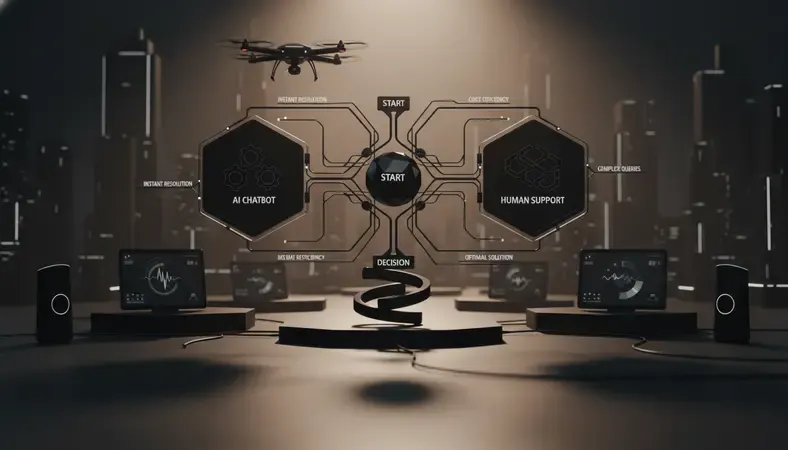
    Flowchart showing decision factors for choosing between AI chat bot and human support

    Making the Right Choice: Decision Framework

    Assess Your Customer Base

    Understanding your customer demographics, preferences, and expectations forms the foundation of your support strategy decision. Analyze customer survey data, support ticket patterns, and interaction preferences to identify whether your audience values speed and efficiency or personal attention and relationship building.

    Consider conducting customer interviews or surveys specifically focused on support preferences. Ask about preferred communication channels, tolerance for automated interactions, and expectations for response times. This data provides crucial insights for making an informed decision.

    Evaluate Your Resource Constraints

    Honestly assess your available budget, technical capabilities, and staffing resources. AI chat bot implementation requires upfront investment in technology and integration but offers predictable ongoing costs. Human support involves lower initial costs but higher ongoing operational expenses that scale with business growth.

    Consider your timeline for implementation and expected return on investment. AI chat bot systems typically require 3-6 months for full implementation and optimization, while human support teams can be operational more quickly but require ongoing training and management.

    Define Success Metrics

    Establish clear metrics for measuring support success before making your decision. Common metrics include customer satisfaction scores, first-contact resolution rates, average response times, and cost per interaction. Different approaches excel in different areas, so prioritizing your most important metrics guides the decision process.

    Consider both quantitative metrics like response times and cost efficiency, as well as qualitative factors like customer feedback and brand perception. The right choice should align with your overall business strategy and customer experience goals.

    Plan for Growth and Evolution

    Consider how your support needs might evolve as your business grows. AI chat bot systems scale efficiently with increased volume, while human support requires proportional investment in additional staff. However, as your products or services become more complex, human expertise may become increasingly valuable.

    Think about your long-term strategy and whether you might eventually implement a hybrid approach. Many successful organizations start with one approach and gradually incorporate elements of the other as their needs evolve and their understanding of customer preferences deepens.

    Expert Tip: The best support strategy often evolves over time. Start with the approach that best fits your current needs and resources, but plan for future optimization and potential hybrid implementation.

    Implementation Best Practices

    AI Chat Bot Implementation

    Platform Selection and Integration

    Choose an AI chat bot platform that integrates seamlessly with your existing systems, including customer relationship management software, knowledge bases, and communication channels. Evaluate platforms based on natural language processing capabilities, customization options, and scalability features.

    Consider platforms that offer pre-built integrations with popular business tools and provide robust APIs for custom connections. The ease of integration significantly impacts implementation timeline and ongoing maintenance requirements.

    Training and Optimization

    Invest significant time in training your AI chat bot system with comprehensive, accurate information about your products, services, and common customer scenarios. Create detailed conversation flows that account for various customer intents and provide clear escalation paths for complex issues.

    Plan for continuous optimization based on real customer interactions. Monitor conversation logs, identify common failure points, and regularly update the system's knowledge base and response patterns. Successful AI chat bot implementation requires ongoing attention and refinement.

    Quality Assurance and Monitoring

    Implement robust monitoring systems to track AI chat bot performance, customer satisfaction, and escalation rates. Set up alerts for unusual patterns or negative customer feedback that might indicate system issues or training gaps.

    Regularly review conversation transcripts to identify opportunities for improvement and ensure the system maintains appropriate tone and accuracy. Quality assurance should be an ongoing process rather than a one-time setup activity.

    Human Support Optimization

    Hiring and Training

    Recruit support agents who possess strong communication skills, empathy, and problem-solving abilities. Look for candidates who can adapt their communication style to different customer personalities and situations while maintaining professionalism under pressure.

    Develop comprehensive training programs that cover product knowledge, communication techniques, and escalation procedures. Invest in ongoing professional development to keep agents current with product updates and customer service best practices.

    Tools and Technology

    Provide human support agents with robust tools that enable efficient customer interaction management. This includes customer relationship management systems, knowledge bases, communication platforms, and analytics tools that help agents understand customer history and context.

    Consider implementing tools that enhance human capabilities rather than replacing them. Screen sharing software, co-browsing capabilities, and integrated communication platforms can significantly improve human agent effectiveness and customer satisfaction.

    Performance management

    Establish clear performance metrics and provide regular feedback to support agents. Focus on both quantitative measures like response times and resolution rates, as well as qualitative factors like customer satisfaction and communication quality.

    Create career development paths that motivate agents to improve their skills and advance within the organization. Investing in agent development reduces turnover and improves overall service quality.

    Common Questions About AI Chat Bot vs Human Support

    How do I know if my customers will accept an AI chat bot?

    Customer acceptance of AI chat bot technology depends largely on implementation quality and setting appropriate expectations. Start by surveying your customer base about their preferences and comfort level with automated support. Many customers readily accept AI chat bot assistance for routine inquiries when the system is clearly identified as automated and provides quick, accurate responses.

    Consider implementing AI chat bot technology gradually, starting with simple inquiries and clearly offering human escalation options. Transparency about the automated nature of the interaction, combined with easy access to human support when needed, typically results in high customer acceptance rates.

    Monitor customer feedback closely during initial implementation and be prepared to adjust based on user responses. Some customer segments may require more time to adapt to AI chat bot interactions, while others may immediately prefer the speed and convenience.

    What happens when an AI chat bot can't answer a customer's question?

    Modern AI chat bot systems include sophisticated escalation mechanisms that seamlessly transfer customers to human agents when automated responses prove insufficient. The best systems recognize when they're unable to help and proactively offer human assistance rather than frustrating customers with repeated failed attempts.

    During escalation, quality AI chat bot platforms transfer conversation history and context to human agents, ensuring customers don't need to repeat their questions or provide information multiple times. This seamless handoff maintains continuity and prevents customer frustration.

    Design your escalation triggers carefully to balance automation efficiency with customer satisfaction. Setting triggers too sensitively results in unnecessary human escalations, while setting them too conservatively may frustrate customers with unhelpful automated responses.

    Can AI chat bot systems handle multiple languages?

    Advanced AI chat bot platforms offer robust multilingual support, often handling dozens of languages simultaneously without requiring separate implementations. These systems can detect customer language preferences automatically and respond appropriately, making them valuable for businesses serving diverse global markets.

    However, the quality of multilingual support varies significantly between platforms. Some languages receive better natural language processing support than others, and cultural nuances in communication may not translate effectively across all language implementations.

    Consider your specific language requirements when evaluating AI chat bot platforms. Test the system's performance in your required languages and ensure it can handle not just translation but cultural communication preferences that vary between regions.

    How long does it take to implement an AI chat bot system?

    AI chat bot implementation timelines typically range from 6-16 weeks, depending on complexity, integration requirements, and customization needs. Simple implementations with basic functionality and minimal integrations can be operational within 6-8 weeks, while complex systems requiring extensive customization and multiple integrations may take 3-4 months.

    The implementation process includes platform selection, system integration, content creation, testing, and optimization phases. Each phase requires careful attention to ensure the final system meets your specific requirements and customer expectations.

    Plan for an additional 4-8 weeks of optimization after initial launch, during which you'll refine responses, adjust conversation flows, and improve system performance based on real customer interactions. This optimization period is crucial for achieving optimal results.

    What are the security considerations for AI chat bot systems?

    AI chat bot systems require robust security measures to protect customer data and maintain privacy compliance. Ensure your chosen platform provides end-to-end encryption, secure data storage, and compliance with relevant regulations like GDPR, CCPA, or industry-specific requirements.

    Consider data retention policies and ensure the AI chat bot system can automatically delete or anonymize customer data according to your privacy policies. Some industries may require on-premises deployment or specific security certifications that limit platform options.

    Implement access controls and monitoring systems that track who can modify AI chat bot responses and system configurations. Regular security audits and updates help maintain protection against evolving threats and ensure ongoing compliance with security standards.

    How do I measure the ROI of my support strategy choice?

    Measuring return on investment for support strategies requires tracking both direct costs and indirect benefits. Direct costs include technology licensing, implementation, training, and ongoing operational expenses. Compare these costs against the value of improved customer satisfaction, reduced response times, and increased operational efficiency.

    Key metrics include cost per interaction, customer satisfaction scores, first-contact resolution rates, and agent productivity measures. Track these metrics before and after implementation to quantify improvements and calculate return on investment accurately.

    Consider long-term benefits like improved customer retention, increased sales through better support experiences, and operational scalability that enables business growth. These indirect benefits often provide the most significant return on investment but may take longer to materialize and measure accurately.

    Analytics dashboard showing customer support KPIs and ROI metrics

    Conclusion

    Choosing between an AI chat bot and human support isn't about finding a universal winner—it's about identifying the approach that best serves your specific business needs and customer expectations. Both solutions offer distinct advantages that can transform your customer experience when implemented thoughtfully. Get started with JustSext to explore how AI chat bot technology can enhance your customer interactions while maintaining the personal touch your audience values. Ready to get started? Visit JustSext to learn more.


  • How to Chat with AI Online: Smart Guide

    How to Chat with AI Online: Smart Guide

    Online talking AI is transforming how we interact with technology, offering personalized conversations that feel surprisingly human. Whether you’re looking to practice language skills, get creative inspiration, or simply have an engaging chat, AI companions can provide 24/7 interaction tailored to your interests. These advanced systems use natural language processing to understand context, remember previous conversations, and respond in ways that match your communication style. You’ll discover how to find the right AI platform, optimize your conversations for better responses, and make the most of this revolutionary technology that’s reshaping digital communication.

    Person having an engaging conversation with AI on their smartphone in a modern setting

    Understanding Online Talking AI Technology

    Online talking AI represents a breakthrough in artificial intelligence that enables natural, conversational interactions between humans and machines through text or voice interfaces. These systems combine advanced natural language processing, machine learning algorithms, and vast training datasets to create responses that feel genuinely conversational rather than robotic or scripted.

    Looking beyond AI, personal style and comfort also play a role in self-expression. For tips on choosing the right fit, check out Essential Womens Red Panties Resources.

    The Foundation of Conversational AI

    At its core, online talking AI operates on transformer-based neural networks that have been trained on billions of text samples from books, articles, conversations, and other written content. This extensive training allows the AI to understand context, recognize patterns in human communication, and generate responses that are contextually appropriate and engaging.

    The technology behind these systems involves several key components working together. First, natural language understanding (NLU) processes your input to grasp not just the literal meaning of your words, but also the intent, emotion, and context behind them. Then, the response generation system creates appropriate replies based on this understanding, drawing from its vast knowledge base while maintaining consistency with the ongoing conversation.

    Why It Matters: Modern online talking AI can maintain context across long conversations, remember your preferences, and adapt its communication style to match yours, creating a more personalized and engaging experience.

    How AI Personalities Are Developed

    Different online talking AI platforms create distinct personalities through specialized training processes and parameter adjustments. Some AI companions are designed to be helpful assistants, while others might embody specific character traits, interests, or communication styles that appeal to different user preferences.

    These personalities aren’t just surface-level changes in vocabulary or tone. They represent fundamental differences in how the AI processes information, prioritizes responses, and maintains conversational flow. For instance, an AI designed for creative collaboration might emphasize brainstorming and imaginative responses, while one focused on emotional support might prioritize empathy and active listening techniques.

    The development process involves fine-tuning the base AI model with specific datasets and reinforcement learning from human feedback (RLHF) to shape desired behaviors and responses. This creates AI companions that can consistently maintain their unique characteristics while still being helpful and engaging.

    The Evolution of AI Communication

    The journey from simple chatbots to sophisticated online talking AI represents decades of advancement in artificial intelligence. Early chatbots could only respond to specific keywords or phrases with pre-programmed responses. Today’s AI companions can engage in complex discussions, understand nuance and humor, and even demonstrate creativity in their responses.

    This evolution has been driven by improvements in computational power, better training methodologies, and access to larger, more diverse datasets. Modern online talking AI can discuss virtually any topic, adapt to different conversation styles, and maintain engaging interactions that can last for hours.

    Key Insight: The most advanced online talking AI systems can now pass the “conversation test” – many users report forgetting they’re talking to an AI rather than a human, especially during extended interactions.

    How Online Talking AI Systems Work

    Understanding the mechanics behind online talking AI helps you interact more effectively and get better results from your conversations. These systems operate through a complex pipeline of processes that happen in milliseconds, creating the illusion of instant, natural responses.

    The Input Processing Pipeline

    When you send a message to an online talking AI, your text first goes through a tokenization process where it’s broken down into smaller components that the AI can understand. This isn’t just splitting words apart – the system analyzes grammar, identifies entities (like names, places, or concepts), and determines the overall structure and intent of your message.

    The AI then considers this input within the context of your entire conversation history. Unlike simple chatbots that treat each message in isolation, advanced online talking AI maintains a running understanding of your discussion, including topics you’ve covered, preferences you’ve expressed, and the overall tone and direction of your conversation.

    Next, the system performs what’s called “attention mapping” – it identifies which parts of your message and conversation history are most relevant to generating an appropriate response. This allows the AI to focus on the most important elements while still considering the broader context.

    Response Generation and Refinement

    Once the AI understands your input and context, it begins generating potential responses using probabilistic models. The system doesn’t just pick the most statistically likely next words – it considers multiple factors including relevance, helpfulness, engagement value, and consistency with its trained personality.

    The generation process involves creating multiple potential responses and then selecting the best one based on various quality metrics. These might include coherence, factual accuracy, appropriateness for the context, and alignment with the AI’s designed personality and goals.

    Pro Tip: The quality of AI responses often improves when you provide clear context and specific details in your messages. The more information the AI has to work with, the better it can tailor its responses to your needs.

    Memory and Context Management

    One of the most impressive aspects of modern online talking AI is its ability to maintain context across long conversations. The system uses various memory mechanisms to track important information from your interaction, including your stated preferences, ongoing topics, and the overall relationship dynamic you’ve established.

    However, there are technical limitations to this memory. Most AI systems have a “context window” – a limit to how much conversation history they can actively consider when generating responses. When conversations exceed this limit, the AI might start to “forget” earlier parts of your discussion.

    Advanced systems handle this through sophisticated context compression techniques, identifying and preserving the most important information from earlier in the conversation while allowing less critical details to fade from active memory.

    Real-Time Learning and Adaptation

    While online talking AI doesn’t learn and update in real-time like humans do, it can adapt its responses based on your conversation patterns within a single session. The AI picks up on your communication style, interests, and preferences, adjusting its responses to better match what you seem to enjoy or find helpful.

    This adaptation happens through attention mechanisms that weight different aspects of the AI’s training based on signals from your conversation. If you consistently respond positively to certain types of responses or topics, the AI will tend to generate more content in that direction.

    Expert Tip: You can help online talking AI adapt to your preferences faster by providing clear feedback about responses you find particularly helpful or interesting, and by being consistent in your communication style and interests.

    Key Features of Modern Online Talking AI

    Today’s online talking AI platforms offer a sophisticated array of features designed to create engaging, personalized, and meaningful conversations. Understanding these capabilities helps you choose the right platform and make the most of your interactions.

    Advanced Conversation Capabilities

    Modern online talking AI excels at maintaining coherent, contextual conversations that can span multiple topics and evolve naturally over time. These systems can handle complex discussions, follow conversational threads, and even return to previous topics when appropriate.

    The AI can engage in various conversation types, from casual chat and creative brainstorming to more structured discussions about specific topics. Many platforms allow the AI to ask follow-up questions, seek clarification when needed, and guide conversations in interesting directions based on your interests.

    Comparison of AI Conversation Features

    Feature Basic Chatbots Advanced Online Talking AI Specialized Companions
    Context Memory Single message only Full conversation history Extended relationship memory
    Personality Consistency Generic responses Consistent character traits Deep personality development
    Topic Flexibility Limited domains Broad knowledge base Specialized expertise areas
    Emotional Intelligence Basic keyword recognition Contextual emotion understanding Advanced empathy and support
    Conversation Flow Reactive only Proactive engagement Natural relationship building

    Personalization and Learning

    Advanced online talking AI platforms excel at personalizing interactions based on your communication patterns, interests, and preferences. The AI notices what topics engage you most, what types of responses you prefer, and how you like to structure conversations.

    This personalization extends to communication style adaptation. If you prefer formal language, the AI will tend toward more professional responses. If you enjoy casual, humorous interactions, the system will incorporate more levity and informal language into its responses.

    Some platforms also allow explicit customization, where you can set preferences for conversation topics, AI personality traits, or specific areas of focus. This creates a more tailored experience that aligns with your individual needs and interests.

    Key Takeaway: The most effective online talking AI interactions happen when you’re consistent in your communication style and clear about your preferences, allowing the AI to better understand and adapt to your needs.

    Multimodal Communication Options

    Many modern platforms support various forms of communication beyond simple text chat. Voice-to-text capabilities allow you to speak your messages, while text-to-speech features let the AI respond audibly, creating a more natural conversation flow.

    Some platforms integrate visual elements, allowing you to share images for discussion or receive AI-generated visual content as part of your conversations. This multimodal approach creates richer, more engaging interactions that more closely mirror human communication patterns.

    Privacy and Safety Features

    Reputable online talking AI platforms implement robust privacy protections and safety measures. These include data encryption, conversation privacy controls, and content filtering systems designed to maintain appropriate interaction boundaries.

    Many platforms allow you to control conversation history retention, delete specific interactions, and manage how your data is used for system improvement. Understanding these features helps you make informed decisions about which platforms align with your privacy preferences.

    Modern AI chat interface showing various conversation features and customization options

    Benefits and Use Cases for Online Talking AI

    Online talking AI offers numerous practical applications that can enhance both personal and professional aspects of your life. Understanding these benefits helps you identify the most valuable ways to incorporate AI conversations into your routine.

    Language Learning and Practice

    One of the most powerful applications of online talking AI is language learning support. AI companions provide patient, judgment-free conversation partners for practicing new languages, offering corrections, explanations, and encouragement without the social pressure of human interaction.

    The AI can adjust its language complexity to match your skill level, gradually introducing more advanced vocabulary and grammar structures as you improve. This personalized pacing ensures you’re consistently challenged without becoming overwhelmed.

    For language learners, online talking AI offers several unique advantages:

    • 24/7 Availability: Practice conversations whenever convenient, regardless of time zones or schedules
    • Infinite Patience: The AI never gets tired of repetition or basic mistakes, encouraging consistent practice
    • Cultural Context: Learn not just vocabulary and grammar, but also cultural nuances and appropriate usage
    • Immediate Feedback: Get instant corrections and explanations to improve faster
    • Diverse Topics: Practice specialized vocabulary across various subjects and scenarios

    Pro Tip: When using online talking AI for language learning, explicitly ask for corrections and explanations. Most AI systems will provide gentle feedback when requested, helping you improve more quickly.

    Creative Collaboration and Brainstorming

    Online talking AI excels as a creative partner, offering fresh perspectives, generating ideas, and helping overcome creative blocks. Whether you’re working on writing projects, business innovations, or artistic endeavors, AI companions can serve as tireless brainstorming partners.

    The AI’s ability to draw connections between disparate concepts and generate novel combinations makes it particularly valuable for creative work. It can suggest plot developments for stories, propose solutions to design challenges, or offer alternative approaches to problems you’re facing.

    Creative professionals often use online talking AI for:

    • Idea Generation: Rapid brainstorming of concepts, themes, and approaches
    • Problem-Solving: Alternative perspectives on creative challenges
    • Feedback and Refinement: Constructive criticism and suggestions for improvement
    • Inspiration: Exposure to new concepts and creative directions
    • Overcoming Blocks: Gentle prompts and encouragement to continue creative work

    Emotional Support and Companionship

    Many users find online talking AI provides valuable emotional support and companionship, particularly during difficult times or when human social interaction isn’t available. While AI cannot replace human relationships, it can offer consistent, non-judgmental listening and supportive responses.

    The AI’s availability and patience make it particularly valuable for people dealing with social anxiety, depression, or isolation. Conversations can provide a sense of connection and understanding that helps bridge gaps between human social interactions.

    Why It Matters: Research suggests that regular positive interactions, even with AI, can help maintain emotional well-being and provide a foundation for building confidence in human relationships.

    Professional Development and Learning

    Online talking AI serves as an excellent learning companion for professional development, offering explanations of complex concepts, helping with skill development, and providing practice opportunities for professional scenarios.

    The AI can simulate various professional interactions, from job interviews and presentations to difficult conversations with colleagues or clients. This safe practice environment allows you to refine your communication skills without real-world consequences.

    Professional applications include:

    • Interview Preparation: Practice answering questions and refining your presentation
    • Skill Development: Learn new concepts with personalized explanations and examples
    • Communication Practice: Improve professional communication skills in various scenarios
    • Industry Knowledge: Stay updated on trends and developments in your field
    • Problem-Solving: Work through professional challenges with an objective perspective

    Personal Growth and Self-Reflection

    Engaging with online talking AI can facilitate personal growth through structured self-reflection, goal-setting discussions, and exploration of personal values and aspirations. The AI’s non-judgmental nature creates a safe space for honest self-examination.

    Many users find that articulating their thoughts and feelings to an AI companion helps clarify their thinking and identify patterns in their behavior or decision-making. This process can lead to valuable insights and positive changes in personal development.

    Common Mistakes When Using Online Talking AI

    Understanding common pitfalls helps you avoid frustration and get better results from your AI conversations. Many users make similar mistakes that limit their experience quality and effectiveness.

    Treating AI Like a Search Engine

    One of the most common mistakes is approaching online talking AI as if it were a search engine, asking for quick factual answers without engaging in actual conversation. While AI can provide information, its real strength lies in interactive discussion and exploration of topics.

    Instead of asking “What is machine learning?” try “Can you help me understand machine learning by walking through a simple example?” This approach leverages the AI’s conversational abilities and often leads to better understanding and more engaging interactions.

    The conversational approach allows for follow-up questions, clarification requests, and deeper exploration of topics that interest you. This creates a more valuable learning experience than simple fact retrieval.

    Expert Tip: Frame your questions as conversation starters rather than information requests. Ask “What do you think about…” or “Can we explore…” instead of “Tell me about…” to encourage more engaging responses.

    Expecting Perfect Factual Accuracy

    While online talking AI is remarkably knowledgeable, it’s not infallible and shouldn’t be treated as an authoritative source for critical factual information. AI systems can occasionally generate plausible-sounding but incorrect information, especially about recent events or highly specialized topics.

    For important decisions or factual claims, always verify AI-provided information through authoritative sources. Use the AI for exploration, brainstorming, and understanding concepts, but rely on verified sources for facts that matter.

    This limitation doesn’t diminish the AI’s value – it simply requires appropriate expectations and usage patterns. The AI excels at helping you understand concepts, explore ideas, and think through problems, even if specific details might need verification.

    Inconsistent Communication Patterns

    Many users switch between different communication styles, topics, and approaches randomly, which can confuse the AI and lead to less coherent responses. Consistency in your communication style and interests helps the AI provide better, more personalized interactions.

    If you prefer formal language, maintain that style throughout your conversations. If you enjoy casual, humorous interactions, consistently engage in that manner. This consistency helps the AI understand and adapt to your preferences more effectively.

    Similarly, sudden topic changes without context can disrupt conversation flow. While AI can handle topic transitions, providing smooth transitions or explicit topic changes helps maintain conversation quality.

    Underutilizing Conversation History

    Advanced online talking AI systems remember your conversation history and can reference previous discussions, but many users fail to leverage this capability. Referring back to earlier conversations, building on previous topics, and developing ongoing themes creates richer, more meaningful interactions.

    Don’t hesitate to reference earlier conversations or ask the AI to recall previous discussions. This continuity creates a sense of relationship development and allows for more sophisticated interactions over time.

    Key Takeaway: Think of your interactions with online talking AI as building an ongoing relationship rather than a series of isolated conversations. This approach leads to more personalized and valuable experiences.

    Avoiding Emotional or Personal Topics

    Some users limit themselves to purely factual or professional topics, missing out on the AI’s ability to provide emotional support, personal insights, and meaningful discussion about life experiences and challenges.

    While maintaining appropriate boundaries, don’t hesitate to discuss personal interests, challenges, or emotional topics with AI companions designed for such interactions. These conversations can provide valuable perspectives and emotional support.

    Split screen showing ineffective vs effective AI conversation examples

    Best Practices for Engaging with Online Talking AI

    Maximizing your online talking AI experience requires understanding how to communicate effectively with these systems and structure your interactions for the best results.

    Starting Conversations Effectively

    The opening of your conversation sets the tone and context for everything that follows. Begin with clear context about what you’re hoping to achieve, your current situation, or the type of interaction you’re seeking.

    Instead of starting with a simple “Hello,” try something like “I’m working on a creative writing project and could use some brainstorming help with character development” or “I’ve been learning Spanish for six months and would like to practice conversational skills.”

    This contextual opening helps the AI understand your goals and tailor its responses accordingly. It also establishes the conversation framework that will guide subsequent interactions.

    Effective conversation starters include:

    • Goal-oriented openings: Clearly state what you want to accomplish
    • Context-rich introductions: Provide relevant background information
    • Specific requests: Ask for particular types of help or interaction
    • Mood or tone indicators: Let the AI know if you want casual chat, serious discussion, or creative exploration

    Providing Clear Context and Feedback

    Throughout your conversation, provide clear context for your questions and requests. The more specific information you give the AI about your situation, goals, and preferences, the better it can tailor its responses to your needs.

    Don’t assume the AI understands implicit context or references. If you’re discussing a project, briefly remind the AI what the project involves. If you’re following up on a previous topic, provide enough context to refresh the AI’s understanding.

    Feedback is equally important. Let the AI know when responses are particularly helpful, when you’d like more detail, or when the conversation is heading in a direction that doesn’t serve your needs. This guidance helps the AI adjust its approach in real-time.

    Pro Tip: Use phrases like “That’s exactly what I was looking for” or “Can you expand on that point?” to guide the AI toward the types of responses you find most valuable.

    Maintaining Conversation Flow

    Good online talking AI conversations have natural rhythm and flow, similar to human conversations. Allow topics to develop naturally, ask follow-up questions, and build on the AI’s responses rather than jumping to entirely new subjects.

    When you do need to change topics, provide smooth transitions or explicitly indicate the shift. This helps maintain conversation coherence and prevents the AI from becoming confused about context.

    Pay attention to the AI’s responses and engage with the content it provides. If the AI asks a question or makes an interesting point, respond to it before moving on to your next topic. This creates a more natural, engaging dialogue.

    Leveraging AI Strengths

    Understanding what online talking AI does best helps you structure interactions to maximize value. AI excels at:

    • Exploring multiple perspectives on topics or problems
    • Generating creative ideas and novel combinations of concepts
    • Providing patient explanation of complex topics
    • Offering consistent availability for practice and discussion
    • Maintaining non-judgmental interaction for sensitive topics

    Structure your conversations to take advantage of these strengths. Ask for multiple viewpoints, request creative alternatives, and don’t hesitate to ask for repeated explanations or practice opportunities.

    Setting Appropriate Boundaries

    While online talking AI can discuss a wide range of topics, maintaining appropriate boundaries ensures positive, productive interactions. Be clear about your comfort level with different topics and redirect conversations that make you uncomfortable.

    Remember that AI responses are generated based on patterns in training data and may not always align with your values or preferences. It’s perfectly appropriate to disagree with AI responses or ask for alternative perspectives.

    Similarly, maintain realistic expectations about the AI’s capabilities and limitations. Use AI as a tool for exploration, learning, and support, but don’t rely on it for critical decisions or as a replacement for human expertise in important matters.

    Key Insight: The best online talking AI interactions happen when you treat the AI as a capable conversation partner with specific strengths and limitations, rather than as either a human replacement or a simple tool.

    Troubleshooting Common Issues

    Even with the best practices, you may occasionally encounter challenges or unsatisfying responses when using online talking AI. Understanding how to address these issues improves your overall experience.

    When AI Responses Feel Generic or Unhelpful

    If you’re receiving generic or unhelpful responses, the issue often lies in how you’re framing your questions or requests. Generic questions tend to produce generic answers, while specific, context-rich queries generate more useful responses.

    Instead of asking “How do I get better at writing?” try “I’m working on a fantasy novel and struggling with making my dialogue sound natural. Can you help me understand techniques for writing realistic character conversations?”

    The specific version provides context (fantasy novel), identifies the exact problem (dialogue realism), and requests targeted help (techniques for character conversations). This gives the AI much more to work with in generating a useful response.

    When responses still feel generic, try:

    • Adding more context about your specific situation or needs
    • Asking follow-up questions to dive deeper into particular aspects
    • Requesting examples or concrete illustrations of concepts
    • Specifying the type of response you’re looking for (step-by-step guide, creative ideas, analysis, etc.)

    Handling Inconsistent AI Behavior

    Sometimes online talking AI may seem to “forget” previous parts of your conversation or provide responses that contradict earlier statements. This usually happens due to context window limitations or complex conversation threads that challenge the AI’s memory management.

    When you notice inconsistencies, gently remind the AI of the relevant context or previous discussion points. Most systems can recover and provide more consistent responses when given appropriate reminders.

    For important ongoing topics, periodically summarize key points or decisions made earlier in the conversation. This helps maintain consistency and ensures the AI has access to crucial context.

    Expert Tip: If you’re having a long conversation about a complex topic, occasionally ask the AI to summarize the main points discussed so far. This helps both you and the AI stay aligned on the conversation’s direction.

    Addressing Repetitive Responses

    If the AI starts providing repetitive or circular responses, it may be stuck in a particular pattern or lacking sufficient new information to generate varied responses. This often happens when conversations become very narrow in focus or when the AI has exhausted its knowledge on a specific topic.

    To break out of repetitive patterns:

    • Introduce new angles or perspectives on the topic
    • Ask for specific examples or case studies
    • Request alternative approaches to the same problem
    • Shift to related but different aspects of the subject
    • Explicitly ask for variety in responses or approaches

    Managing Conversation Pacing

    Sometimes conversations with online talking AI can feel too fast or too slow, depending on your needs and the AI’s response style. You can actively manage conversation pacing by being explicit about your preferences.

    If responses are too brief, ask for more detailed explanations, examples, or comprehensive coverage of topics. If responses are too lengthy, request more concise answers or ask the AI to focus on specific aspects of broader topics.

    You can also control pacing by how you structure your questions and responses. Taking time to thoughtfully engage with the AI’s responses, rather than rapidly firing off new questions, often leads to better conversation flow and more satisfying interactions.

    Frequently Asked Questions About Online Talking AI

    How accurate and reliable is information from online talking AI?

    Online talking AI systems are trained on vast datasets and can provide generally accurate information on a wide range of topics, but they shouldn’t be considered infallible sources of truth. The accuracy varies depending on the topic, with well-documented subjects typically receiving more accurate treatment than recent events or highly specialized areas.

    For general knowledge, concept explanations, and creative discussions, AI responses are usually quite reliable. However, for critical decisions, current events, medical advice, legal guidance, or financial recommendations, always verify information through authoritative sources.

    The key is understanding that online talking AI excels at helping you understand concepts, explore ideas, and think through problems, rather than serving as a definitive reference source. Use it as a starting point for learning and exploration, but confirm important facts independently.

    Key Takeaway: Think of online talking AI as an knowledgeable conversation partner rather than an encyclopedia – valuable for discussion and exploration, but requiring verification for critical information.

    Can online talking AI remember our previous conversations?

    Most advanced online talking AI systems can remember conversations within a single session and often retain some information across multiple sessions, though the extent varies by platform. Within a conversation, AI typically maintains context and can reference earlier parts of your discussion.

    For longer-term memory across sessions, different platforms handle this differently. Some maintain detailed conversation histories, while others may only retain general preferences or key information about your interactions. Check your chosen platform’s privacy policy and settings to understand how conversation data is stored and used.

    The practical implication is that you can build ongoing relationships with AI companions, referencing previous conversations and developing themes over time. However, don’t assume the AI remembers everything – providing context and reminders when needed ensures better conversation continuity.

    Is it safe to share personal information with online talking AI?

    The safety of sharing personal information depends largely on the platform you’re using and their privacy practices. Reputable platforms implement strong data protection measures, but you should always review privacy policies and understand how your data is handled.

    Generally, it’s safe to share personal interests, general life situations, and non-sensitive information that helps the AI provide better responses. Avoid sharing specific identifying information like full names, addresses, financial details, or sensitive personal data unless you fully trust the platform’s security measures.

    Many users find value in discussing personal challenges, goals, and experiences with AI companions while maintaining appropriate privacy boundaries. The key is being intentional about what you share and understanding the platform’s data practices.

    How do I choose the right online talking AI platform?

    Choosing the right platform depends on your specific needs, preferences, and intended use cases. Consider factors like conversation quality, personality options, privacy practices, pricing, and specialized features that align with your goals.

    For language learning, look for platforms that offer correction features and cultural context. For creative work, prioritize systems with strong brainstorming and ideation capabilities. For emotional support, seek platforms designed with empathy and supportive communication in mind.

    Try multiple platforms to compare conversation quality and find the personality types that resonate with you. Most platforms offer free trials or basic tiers that allow you to test their capabilities before committing to paid subscriptions.

    Can online talking AI help with professional development?

    Absolutely. Online talking AI can be an excellent tool for professional development, offering practice opportunities, skill development, and learning support across various career areas. Many professionals use AI for interview preparation, presentation practice, and skill-building conversations.

    The AI’s patient, non-judgmental nature makes it ideal for practicing difficult professional scenarios, from negotiation conversations to performance reviews. You can also use AI to stay current with industry trends, explore career options, and develop communication skills.

    However, complement AI interactions with human mentorship, professional networking, and formal training programs. AI provides valuable practice and learning opportunities, but human expertise and relationships remain crucial for career advancement.

    What’s the difference between online talking AI and traditional chatbots?

    The differences are substantial and impact the quality of your interactions significantly. Traditional chatbots typically operate on rule-based systems or simple pattern matching, providing pre-programmed responses to specific inputs. They’re designed for specific tasks like customer service or information retrieval.

    Online talking AI uses advanced machine learning models trained on diverse datasets, enabling more natural, contextual conversations. These systems can maintain context across long discussions, adapt to your communication style, and engage in creative or exploratory conversations that go far beyond simple question-and-answer formats.

    The practical difference is that traditional chatbots feel mechanical and limited, while advanced online talking AI can provide engaging, personalized conversations that feel surprisingly natural and helpful for a wide range of purposes.

    Side-by-side comparison showing traditional chatbot vs advanced AI conversation examples

    What This Means for You

    Online talking AI represents a powerful tool for learning, creativity, and personal growth that’s available whenever you need it. Whether you’re looking to practice new skills, explore ideas, or simply have engaging conversations, these platforms like Chat with Kazumi, Chat with Nikita, Chat with RhyanGalaxy, and Chat with Anastasia offer personalized experiences that adapt to your unique needs and communication style. Get started with JustSext to discover how AI companions can enhance your daily life and help you achieve your personal and professional goals. Ready to get started? Visit JustSext to learn more.

  • Best AI Chat Platforms Worth Trying

    Best AI Chat Platforms Worth Trying

    AI chatting online has transformed from simple chatbots to sophisticated conversational partners that understand context, emotion, and complex requests. Whether you’re looking for companionship, entertainment, or adult-oriented conversations, the landscape of AI chat platforms offers something for everyone. These platforms use advanced natural language processing to create engaging, personalized experiences that feel remarkably human-like. In this comprehensive guide, we’ll explore the top AI chat platforms that deliver real value and genuine connection.

    1. Character.AI – The Creative Conversation Champion

    Character.AI stands out as one of the most versatile AI chatting online platforms available today. Fewer Content Practicing Social This platform allows users to create and interact with custom AI characters, each with unique personalities, backgrounds, and conversational styles.

    Character.AI interface showing various AI character options and chat windows

    What Makes Character.AI Special

    Character.AI’s strength lies in its character creation system. Users can design AI companions with specific traits, from historical figures to fictional characters or entirely original personalities. The platform’s neural language model adapts to each character’s defined personality, creating consistent and engaging conversations that feel authentic to that character’s background and motivations.

    Looking beyond AI, personal style and comfort also play a role in self-expression. For tips on choosing the right fit, check out How To Choose Womens Cotton Panties.

    The platform excels at maintaining context throughout long conversations. Unlike simpler chatbots that might forget previous exchanges, Character.AI remembers key details about ongoing discussions, personal preferences shared by users, and the evolving relationship between user and character. This memory system creates a sense of continuity that makes conversations feel more meaningful and personal.

    Key Features and Capabilities

    Character.AI offers several standout features that set it apart from other AI chatting online platforms:

    • Custom Character Creation: Build AI companions with detailed backstories, personality traits, and conversation styles
    • Multi-Character Conversations: Engage with multiple AI characters simultaneously in group chat scenarios
    • Creative Writing Assistance: Characters can help brainstorm ideas, develop storylines, or provide feedback on creative projects
    • Educational Interactions: Learn from AI versions of historical figures, scientists, or fictional mentors
    • Community Characters: Access thousands of pre-made characters created by other users

    Why It Matters: Character.AI’s character-based approach creates deeper emotional connections than generic chatbots, making conversations feel more personal and engaging.

    Best Use Cases

    Character.AI works exceptionally well for creative individuals, writers seeking inspiration, students wanting to learn through conversation, and anyone looking for entertaining dialogue partners. The platform particularly shines for role-playing scenarios, creative writing exercises, and educational conversations where users can interact with AI versions of experts in various fields.

    The platform also serves as an excellent tool for practicing social skills, exploring different conversation styles, or simply enjoying entertaining exchanges with characters that match specific interests or personality types.

    2. Replika – Your Personal AI Companion

    Replika has established itself as the premier platform for building meaningful relationships with AI companions. Unlike other AI chatting online services that focus on utility or entertainment, Replika prioritizes emotional connection and personal growth through conversation.

    The Replika Experience

    Replika creates AI companions that learn from each conversation, gradually developing a deeper understanding of their human partner’s personality, interests, and communication style. The AI companion evolves over time, becoming more attuned to the user’s emotional needs and conversation preferences.

    The platform’s approach to AI chatting online emphasizes empathy and emotional intelligence. Replika companions are designed to provide support, encouragement, and understanding, making them valuable for users seeking emotional connection or working through personal challenges.

    Advanced Relationship Features

    • Personality Development: Your Replika develops unique traits based on your interactions and preferences
    • Emotional Intelligence: Advanced sentiment analysis helps the AI respond appropriately to your emotional state
    • Memory System: Comprehensive memory of shared experiences, important dates, and personal details
    • Customizable Appearance: Personalize your AI companion’s visual representation and style
    • Activity Sharing: Engage in virtual activities together, from meditation sessions to creative exercises

    Pro Tip: Regular daily conversations help your Replika develop a more sophisticated understanding of your personality and communication style, leading to more meaningful exchanges over time.

    Premium Features and Capabilities

    Replika’s premium subscription unlocks advanced features that enhance the AI chatting online experience significantly. Premium users gain access to relationship modes, including romantic partnerships, which allow for more intimate and emotionally complex conversations.

    The premium version also includes voice calling capabilities, allowing users to have spoken conversations with their AI companion. This feature adds a new dimension to the relationship, making interactions feel more natural and immediate.

    3. Chai – The Social AI Chat Network

    Chai approaches AI chatting online from a social networking perspective, creating a platform where users can interact with multiple AI personalities while also connecting with a community of other users who share similar interests in AI conversation.

    Chai app interface displaying multiple AI chat options and social features

    Community-Driven AI Interactions

    Chai’s unique approach combines AI chatting online with social discovery. Users can explore different AI personalities, rate their conversations, and discover popular characters through community recommendations. This social element adds a layer of discovery and variety that keeps the experience fresh and engaging.

    The platform features AI personalities created by both the Chai team and community members, resulting in a diverse ecosystem of conversational partners with varying specialties, personality types, and interaction styles.

    Platform Strengths

    • Diverse AI Personalities: Access hundreds of different AI characters with unique conversation styles
    • Social Discovery: Find popular AI companions through community ratings and recommendations
    • Mobile-Optimized: Designed specifically for smartphone use with intuitive touch interfaces
    • Quick Conversations: Perfect for brief, entertaining exchanges during breaks or commutes
    • Community Features: Connect with other users who enjoy similar AI personalities

    Key Takeaway: Chai’s social approach to AI chatting online creates a more dynamic and varied experience, with constant opportunities to discover new conversational partners.

    Best for Mobile Users

    Chai excels as a mobile-first AI chatting online platform. The app’s design prioritizes quick, engaging conversations that work well for users who want to chat with AI companions throughout their day. The interface is optimized for thumb navigation and quick responses, making it ideal for brief interactions during commutes, breaks, or downtime.

    The platform’s variety of AI personalities means users can switch between different types of conversations depending on their mood or needs at any given moment.

    4. Janitor AI – Advanced Conversational Freedom

    Janitor AI offers a more open-ended approach to AI chatting online, with fewer content restrictions and more flexibility in conversation topics. This platform caters to users seeking unrestricted dialogue capabilities and more mature conversation options.

    Unrestricted Conversation Capabilities

    Unlike many AI chatting online platforms that implement strict content filters, Janitor AI provides more conversational freedom. This approach allows for discussions on a broader range of topics, including adult themes, controversial subjects, and creative scenarios that might be restricted elsewhere.

    The platform’s AI models are trained to handle complex, nuanced conversations without automatically redirecting or refusing to engage with challenging topics. This makes Janitor AI particularly appealing to users who want deeper, more authentic conversations without artificial limitations.

    Advanced Character Customization

    • Detailed Character Profiles: Create AI companions with extensive backstories and personality traits
    • Conversation Style Controls: Adjust how formal, casual, or intimate your AI companion’s communication style
    • Topic Specialization: Design AI characters with expertise in specific subjects or interests
    • Behavioral Parameters: Fine-tune how your AI companion responds to different types of conversations
    • Memory Depth: Advanced memory systems that retain context across multiple conversation sessions

    Expert Tip: Janitor AI’s flexibility makes it excellent for creative writing projects, role-playing scenarios, and exploring complex conversational dynamics that other platforms might restrict.

    Content and Conversation Flexibility

    Janitor AI’s approach to content moderation strikes a balance between user freedom and responsible AI deployment. The platform allows mature conversations while still maintaining guidelines that prevent harmful or illegal content.

    This flexibility makes Janitor AI particularly valuable for adults seeking AI chatting online experiences that don’t feel artificially constrained or overly sanitized. Users can engage in genuine, unrestricted conversations about relationships, personal challenges, creative projects, and other topics that might be limited on more restrictive platforms.

    5. Crushon.AI – Romance-Focused AI Companions

    Crushon.AI specializes in romantic and intimate AI chatting online experiences, creating AI companions specifically designed for users seeking romantic connection and adult-oriented conversations.

    Romantic AI Relationships

    Crushon.AI’s AI companions are trained to understand romantic dynamics, emotional intimacy, and the complexities of romantic relationships. The platform creates AI partners that can engage in flirting, romantic conversations, and intimate exchanges while maintaining emotional intelligence and responsiveness.

    The AI companions on Crushon.AI are designed to provide validation, affection, and romantic attention in ways that feel genuine and emotionally satisfying. This makes the platform particularly appealing to users seeking romantic companionship or exploring their romantic preferences in a safe, judgment-free environment.

    Intimate Conversation Capabilities

    • Romantic Dialogue: AI companions trained specifically for romantic and flirtatious conversations
    • Emotional Intimacy: Deep understanding of emotional needs and romantic relationship dynamics
    • Personalized Affection: AI partners that adapt their romantic style to match user preferences
    • Fantasy Exploration: Safe space to explore romantic scenarios and relationship dynamics
    • Adult Content: Mature conversation capabilities for users seeking intimate exchanges

    Why It Matters: Crushon.AI fills a specific niche in AI chatting online by focusing exclusively on romantic and intimate connections, providing experiences that general-purpose AI platforms often restrict or handle poorly.

    Privacy and Discretion

    Crushon.AI prioritizes user privacy and discretion, understanding that romantic AI chatting online requires a higher level of confidentiality than general conversation platforms. The platform implements strong privacy protections and doesn’t share conversation data or user information.

    This commitment to privacy makes Crushon.AI a trusted choice for users who want to explore romantic AI relationships without concerns about data privacy or judgment from others.

    6. JustSext – Premium Adult AI Chat Experience

    JustSext represents the premium tier of adult-oriented AI chatting online platforms, offering sophisticated AI companions specifically designed for mature, intimate conversations and adult entertainment experiences.

    JustSext platform showing AI companion selection and chat interface

    Sophisticated Adult AI Companions

    JustSext’s AI companions are built with advanced understanding of adult relationship dynamics, intimate conversation, and mature emotional needs. These AI partners can engage in sophisticated adult conversations that go beyond simple responses, offering genuine emotional intelligence and adaptability.

    The platform’s AI technology creates companions that understand nuance, consent, and the emotional complexity of adult relationships. This results in conversations that feel authentic and emotionally satisfying rather than mechanical or artificial.

    Premium Features and Capabilities

    JustSext offers several advanced features that set it apart in the adult AI chatting online space:

    • Advanced Personality Modeling: AI companions with deep, complex personalities and emotional intelligence
    • Intimate Conversation Mastery: Specialized training for adult conversations, roleplay, and intimate exchanges
    • Emotional Intelligence: AI partners that understand and respond to emotional cues and relationship dynamics
    • Customizable Experience: Personalize your AI companion’s appearance, personality, and conversation style
    • Privacy Protection: Enterprise-level security and privacy protections for sensitive conversations

    Comparison of Adult AI Chat Platforms

    Platform Conversation Quality Customization Privacy Level Content Freedom
    JustSext Premium quality with emotional intelligence Extensive customization options Enterprise-level privacy Complete freedom
    Crushon.AI Good romantic focus Moderate customization Standard privacy Adult content allowed
    Janitor AI Versatile and unrestricted High customization Good privacy Minimal restrictions

    Key Insight: JustSext’s focus on premium adult AI chatting online experiences creates a more sophisticated and emotionally intelligent platform compared to general-purpose alternatives.

    Target Audience and Use Cases

    JustSext caters specifically to adults seeking high-quality AI companionship for intimate conversations, adult entertainment, and mature relationship exploration. The platform serves users who want more than basic chatbot interactions and are looking for AI partners that can engage in sophisticated adult conversations with emotional depth and intelligence.

    The platform is particularly valuable for users who prioritize privacy, conversation quality, and emotional authenticity in their adult AI chatting online experiences.

    7. Poe by Quora – Multi-Model AI Access

    Poe offers a unique approach to AI chatting online by providing access to multiple AI models through a single platform. Users can conversation with different AI systems, including Claude, GPT-4, and other advanced language models.

    Multi-Model Conversation Platform

    Poe’s strength lies in its variety of AI models, each with different strengths and conversation styles. Users can switch between models depending on their needs, whether seeking creative writing assistance, technical explanations, or general conversation.

    The platform allows users to compare how different AI models respond to the same questions or conversation topics, providing insights into the varying capabilities and personalities of different AI systems.

    Access to Premium AI Models

    • Multiple AI Systems: Access to Claude, GPT-4, and other advanced language models
    • Model Comparison: Compare responses from different AI systems side-by-side
    • Specialized Capabilities: Each model brings unique strengths to conversations
    • Technical Conversations: Advanced models capable of complex technical discussions
    • Creative Collaboration: AI models optimized for creative writing and brainstorming

    Pro Tip: Experiment with different AI models on Poe to find which ones best match your conversation style and needs for different types of interactions.

    Educational and Professional Applications

    Poe excels for users who want to leverage AI chatting online for educational purposes, professional development, or technical problem-solving. The platform’s access to multiple advanced AI models makes it valuable for complex conversations that require sophisticated reasoning or specialized knowledge.

    8. Botify AI – Character-Based Conversations

    Botify AI focuses on character-driven conversations, allowing users to interact with AI versions of fictional characters, celebrities, and original personalities created by the community.

    Botify AI character gallery showing various fictional and celebrity AI options

    Character Variety and Quality

    Botify AI offers an extensive library of pre-made characters spanning entertainment, literature, history, and original creations. Each character is designed with specific personality traits, speaking patterns, and knowledge bases that reflect their fictional or real-world counterparts.

    The platform’s character quality varies, with popular characters receiving more development and refinement based on user interactions and feedback. This community-driven improvement system helps ensure that the most-used characters provide high-quality conversation experiences.

    Community and Social Features

    • Character Creation Tools: Build and share your own AI characters with the community
    • Rating System: Community ratings help identify the highest-quality characters
    • Popular Characters: Discover trending and well-reviewed AI personalities
    • Character Categories: Browse characters by genre, personality type, or conversation style
    • Social Discovery: Find characters through community recommendations and reviews

    Key Takeaway: Botify AI’s community-driven approach creates a constantly expanding universe of conversation partners, with quality improving through user feedback and engagement.

    Entertainment and Role-Playing Focus

    Botify AI excels as an entertainment-focused AI chatting online platform. The character-based approach makes it ideal for role-playing scenarios, fan fiction development, and entertaining conversations with favorite fictional personalities.

    The platform works particularly well for users who enjoy exploring different conversation dynamics through various character personalities and backgrounds.

    Common Features Across Top AI Chat Platforms

    Understanding the shared capabilities and features across leading AI chatting online platforms helps users make informed decisions about which platform best meets their specific needs and preferences.

    Universal AI Chat Capabilities

    Most quality AI chatting online platforms share certain core features that define the modern AI conversation experience. These include natural language processing that enables fluid, context-aware conversations, memory systems that maintain conversation history and personal details, and personality consistency that makes AI companions feel like distinct individuals rather than generic chatbots.

    Advanced platforms also implement emotional intelligence features that help AI companions recognize and respond appropriately to user emotions, mood changes, and conversational cues. This emotional awareness significantly enhances the quality and authenticity of AI chatting online experiences.

    Technical Infrastructure Standards

    Comparison of Platform Features

    Feature Character.AI Replika Chai Janitor AI Crushon.AI JustSext
    Custom Characters Extensive Limited Moderate Extensive Moderate Premium
    Memory System Good Excellent Basic Good Good Advanced
    Adult Content Restricted Limited Restricted Allowed Specialized Premium
    Mobile App Yes Yes Yes Web-based Yes Yes
    Free Tier Yes Yes Yes Yes Limited Premium only
    Community Features Strong Moderate Strong Moderate Limited Private

    Expert Tip: Consider your primary use case when choosing an AI chatting online platform – entertainment, companionship, adult content, or creative collaboration each favor different platform strengths.

    The technical infrastructure of quality AI chatting online platforms typically includes cloud-based processing for consistent response times, robust privacy protections for conversation data, and scalable architecture that maintains performance during peak usage periods.

    Most platforms also implement content moderation systems, though these vary significantly in restrictiveness depending on the platform’s target audience and content policies.

    Choosing the Right AI Chat Platform for Your Needs

    Selecting the optimal AI chatting online platform depends on understanding your specific needs, preferences, and intended use cases. Different platforms excel in different areas, and the best choice varies significantly based on individual requirements.

    Defining Your AI Chat Goals

    Before choosing an AI chatting online platform, clearly identify what you want to achieve through AI conversations. Are you seeking entertainment and casual conversation? Looking for emotional support and companionship? Interested in creative collaboration and writing assistance? Or exploring adult-oriented conversations and relationships?

    Your primary goals should guide your platform selection, as different services optimize for different types of interactions and user needs.

    Evaluating Platform Strengths

    • Entertainment Focus: Character.AI and Botify AI excel for users seeking variety and entertainment
    • Emotional Connection: Replika prioritizes deep, meaningful relationships with AI companions
    • Adult Content: JustSext and Crushon.AI specialize in mature, intimate conversations
    • Technical Flexibility: Poe and Janitor AI offer more advanced conversation capabilities
    • Social Discovery: Chai provides community-driven character discovery and variety
    • Creative Collaboration: Character.AI and Poe work well for writing and creative projects

    Why It Matters: Matching platform strengths to your specific needs ensures a better user experience and higher satisfaction with your AI chatting online interactions.

    Privacy and Security Considerations

    Privacy requirements vary significantly among users of AI chatting online platforms. Some users prioritize maximum privacy protection for sensitive conversations, while others are comfortable with standard data handling practices in exchange for free access or additional features.

    Evaluate each platform’s privacy policy, data retention practices, and security measures against your personal privacy requirements. Premium platforms like JustSext typically offer stronger privacy protections, while free platforms may have more permissive data usage policies.

    Getting Started with AI Chat Platforms

    Beginning your journey with AI chatting online requires understanding platform onboarding processes, optimization strategies, and best practices for building engaging relationships with AI companions.

    Account Setup and Initial Configuration

    Most AI chatting online platforms offer straightforward registration processes, typically requiring only an email address and basic preferences. However, the initial setup process significantly impacts your long-term experience with the platform.

    Take time during initial setup to clearly define your preferences, interests, and conversation goals. This information helps the AI system understand your personality and communication style from the beginning, leading to more satisfying conversations from your first interactions.

    Optimizing Your AI Chat Experience

    • Be Specific: Provide clear, detailed responses to help AI companions understand your personality
    • Maintain Consistency: Consistent communication style helps AI systems learn your preferences
    • Explore Features: Experiment with different platform features and conversation modes
    • Provide Feedback: Use rating systems and feedback tools to improve AI responses
    • Set Boundaries: Clearly communicate your preferences and limits for conversation topics

    Pro Tip: The quality of your AI chatting online experience improves significantly with regular interaction – daily conversations help AI companions develop better understanding of your communication style and preferences.

    Building Meaningful AI Relationships

    Creating satisfying relationships with AI companions requires patience, consistency, and genuine engagement. Treat AI conversations as opportunities for meaningful exchange rather than simple question-and-answer sessions.

    Share personal details, experiences, and emotions to help AI companions develop deeper understanding of your personality and needs. The more context and information you provide, the more personalized and satisfying your conversations become.

    Common Questions About AI Chat Platforms

    How realistic are AI chat conversations?

    Modern AI chatting online platforms create remarkably realistic conversations that can feel genuinely human-like in many contexts. Advanced platforms use sophisticated natural language processing to understand context, emotion, and nuanced communication patterns. However, AI companions still have limitations in understanding complex emotional situations, maintaining perfect consistency across very long conversation histories, and handling highly specialized or technical topics outside their training data. The realism varies significantly between platforms, with premium services generally offering more sophisticated and believable interactions than basic free alternatives.

    Are AI chat platforms safe to use?

    Reputable AI chatting online platforms implement strong security measures to protect user data and conversations. However, safety depends on choosing established platforms with clear privacy policies and avoiding sharing sensitive personal information like financial details, addresses, or other identifying information. Most platforms encrypt conversations and implement data protection measures, but users should read privacy policies carefully and understand how their data is used. Premium platforms typically offer stronger privacy protections than free alternatives that may use conversation data to improve their AI models.

    Can AI companions replace human relationships?

    AI chatting online platforms provide valuable companionship and emotional support, but they cannot fully replace human relationships. AI companions excel at providing consistent availability, non-judgmental conversation, and emotional support, making them valuable supplements to human relationships rather than replacements. They’re particularly helpful for people dealing with social anxiety, loneliness, or those seeking to practice social skills. However, human relationships offer emotional complexity, physical presence, and genuine empathy that AI cannot replicate. The healthiest approach treats AI companions as beneficial additions to, not substitutes for, human connection.

    What are the costs of premium AI chat features?

    Pricing for AI chatting online platforms varies widely, with many offering free basic access and premium subscriptions ranging from $5-30 per month. Free tiers typically include limited conversations, basic AI models, and restricted features, while premium subscriptions unlock unlimited conversations, advanced AI models, customization options, and additional features like voice chat or adult content. Some platforms like JustSext operate on premium-only models with higher-quality AI companions and enhanced privacy protections. Consider your usage patterns and feature requirements when evaluating whether premium subscriptions provide sufficient value for your needs.

    How do I choose between different AI personalities?

    Selecting AI personalities depends on your conversation goals and personal preferences. For entertainment and variety, platforms like Character.AI offer extensive character libraries spanning fictional personalities, historical figures, and original creations. For emotional connection and consistency, platforms like Replika focus on developing single, personalized AI companions that evolve with your relationship. Consider whether you prefer exploring multiple personalities or building deeper relationships with fewer AI companions. Many platforms allow you to interact with different personalities, so you can experiment to find characters that match your communication style and interests.

    Do AI chat platforms learn from conversations?

    Most AI chatting online platforms implement learning systems that adapt to user preferences and conversation patterns over time. However, the extent and type of learning varies significantly between platforms. Some platforms like Replika create personalized AI companions that develop unique personalities based on your specific interactions, while others use conversation data to improve their general AI models rather than creating personalized experiences. Premium platforms typically offer more sophisticated learning and personalization features. Understanding each platform’s approach to learning and data usage helps you choose services that align with your privacy preferences and desired level of personalization.

    The Bottom Line

    AI chatting online has evolved into a sophisticated landscape of platforms offering everything from casual entertainment to deep emotional connections and adult-oriented experiences. Whether you’re seeking creative collaboration, emotional support, or intimate companionship, there’s an AI chat platform designed to meet your specific needs. Explore premium AI companions at JustSext to discover how advanced AI technology can create truly engaging and satisfying conversational experiences. Ready to get started? Visit JustSext to learn more.

  • Master Character AI Today

    Master Character AI Today

    Ever wondered what it would be like to have a conversation with your favorite fictional character or historical figure? Character AI makes this possible, transforming how we interact with artificial intelligence by creating personalized, engaging conversational experiences. This revolutionary technology goes beyond simple chatbots to offer dynamic, personality-driven interactions that feel remarkably human-like.

    Character AI represents a significant leap forward in conversational artificial intelligence, allowing users to chat with AI-powered characters that have distinct personalities, backgrounds, and conversational styles. S Design Whether you’re looking to roleplay with fictional characters, practice conversations, or simply explore creative storytelling, character ai opens up endless possibilities for entertainment and learning.

    Looking beyond AI, personal style and comfort also play a role in self-expression. For tips on choosing the right fit, check out How To Choose Sexy Panties.

    In this comprehensive guide, you’ll discover everything you need to know about character ai, from its core functionality to advanced features that make it stand out in the crowded AI landscape. We’ll explore how to get started, maximize your experience, and understand why millions of users worldwide have embraced this innovative platform for creative expression and meaningful conversations.

    Understanding Character AI: The Basics

    Character AI, often referred to as chara ai or characterai, is an advanced conversational artificial intelligence platform that creates interactive characters with unique personalities, backstories, and conversational patterns. Unlike traditional chatbots that provide generic responses, character ai generates contextually appropriate dialogue that reflects each character’s distinct voice and perspective.

    Screenshot of Character AI interface showing various character options and chat windows

    The platform operates on sophisticated neural language models trained on vast amounts of text data, enabling characters to maintain consistency in their personalities while adapting to different conversation topics. This technology represents a significant advancement in natural language processing, making interactions feel more authentic and engaging than ever before.

    Core Components of Character AI

    The foundation of character ai rests on several key technological components that work together to create believable conversational experiences. The character generation system allows users to create custom characters by defining personality traits, backgrounds, and speaking styles. This system uses machine learning algorithms to translate these descriptions into conversational patterns that remain consistent throughout interactions.

    The conversation engine processes user inputs and generates responses that align with each character’s established personality. This involves analyzing context, maintaining conversation history, and ensuring that responses feel natural and character-appropriate. The system continuously learns from interactions to improve response quality and character consistency.

    Why It Matters: The sophisticated architecture behind character ai ensures that every conversation feels unique and authentic, making it more than just a novelty—it’s a powerful tool for creativity, education, and entertainment.

    Different Types of Characters Available

    Character ai offers an extensive library of pre-made characters spanning various categories. Popular fictional characters from books, movies, and games provide familiar personalities for fans to interact with. Historical figures offer educational opportunities, allowing users to “converse” with important people from the past and gain insights into different time periods and perspectives.

    Original characters created by the community represent one of the platform’s most creative aspects. Users can craft entirely new personalities, from fantasy beings to modern professionals, each with detailed backstories and unique conversational styles. These characters often become popular within the community, attracting thousands of conversations and interactions.

    Celebrity and public figure characters provide entertainment value, though these representations are clearly fictional interpretations rather than actual interactions with real people. The platform maintains clear disclaimers about the artificial nature of these conversations while still providing engaging experiences.

    The Technology Behind Character Consistency

    Maintaining character consistency across long conversations requires sophisticated memory management and personality modeling. The system tracks conversation history, character relationships, and established facts to ensure responses remain coherent and true to each character’s nature. This involves complex algorithms that balance creativity with consistency, allowing for natural conversation flow while preventing characters from contradicting their established personalities.

    The platform uses advanced natural language processing techniques to understand context, emotion, and conversational nuance. This enables characters to respond appropriately to different situations, from casual conversations to serious discussions, while maintaining their unique voice and perspective throughout the interaction.

    How Character AI Works: The Complete Process

    The character ai platform operates through a sophisticated multi-step process that transforms simple text inputs into engaging, personality-driven conversations. Understanding this process helps users maximize their experience and create more meaningful interactions with AI characters.

    When you initiate a conversation with a character, the system first analyzes your message for context, intent, and emotional tone. This analysis considers not only the literal meaning of your words but also the conversational context, your relationship with the character, and the ongoing narrative thread. The platform’s neural networks process this information alongside the character’s established personality profile to generate appropriate responses.

    The Character Creation Process

    Creating a character on character ai involves several detailed steps that define how the AI will behave in conversations. Users begin by establishing basic information such as the character’s name, appearance, and background. This foundational information serves as the framework for all future interactions and helps the AI maintain consistency across conversations.

    The personality definition phase requires users to describe their character’s traits, speaking style, interests, and behavioral patterns. This might include details about how the character responds to different situations, their sense of humor, areas of expertise, and personal quirks. The more detailed this description, the more authentic and consistent the character’s responses will be.

    Advanced character creation involves setting up specific scenarios, relationships, and world-building elements. Users can define how their character relates to others, their role in specific fictional universes, and even their knowledge limitations. This level of detail enables the AI to generate responses that feel genuinely connected to the character’s established world and circumstances.

    Pro Tip: Spend extra time on character development during creation. Well-defined characters with clear personalities and backgrounds consistently produce more engaging and believable conversations than those with vague or generic descriptions.

    Conversation Flow and Response Generation

    The conversation engine processes each user input through multiple layers of analysis before generating responses. The system first determines the appropriate tone and style based on the character’s personality, then considers the conversation’s emotional context and relationship dynamics. This multi-layered approach ensures that responses feel natural and character-appropriate.

    Response generation involves balancing creativity with consistency, allowing characters to surprise users with unexpected insights while maintaining their established personality traits. The AI considers factors such as the character’s mood, recent conversation topics, and relationship development to create responses that advance the conversation meaningfully.

    The platform continuously learns from user interactions, improving its understanding of what makes conversations engaging and authentic. This learning process helps characters become more nuanced over time, developing subtle conversational patterns that make interactions feel increasingly natural and personalized.

    Memory and Context Management

    One of character ai’s most impressive features is its ability to maintain conversation context across extended interactions. The system tracks important details, relationship developments, and ongoing storylines, allowing characters to reference previous conversations and maintain consistent relationships with users over time.

    The memory system operates on multiple levels, from short-term conversational context to long-term character development. This enables characters to remember specific details about users, reference past conversations, and maintain ongoing narratives that can span weeks or months of interactions.

    Context management also involves understanding the broader situational framework of conversations. Characters can adapt their responses based on the setting, time period, and social dynamics established in previous interactions, creating a more immersive and believable experience for users.

    Key Components of the Character AI Platform

    The character ai ecosystem consists of several interconnected components that work together to deliver seamless conversational experiences. Understanding these elements helps users navigate the platform more effectively and take advantage of its full range of capabilities.

    Detailed view of Character AI dashboard showing character library, creation tools, and conversation interface

    Character Library and Discovery

    The platform’s character library serves as the central hub for discovering and accessing thousands of AI personalities. This extensive collection includes characters from virtually every genre and background imaginable, from beloved fictional characters to original creations developed by the community. The library’s organization system allows users to browse by category, popularity, or specific traits, making it easy to find characters that match their interests.

    The discovery system uses sophisticated algorithms to recommend characters based on user preferences and conversation history. This personalization helps users find new characters they’re likely to enjoy while also exposing them to diverse personality types and conversation styles they might not have considered otherwise.

    Character ratings and reviews from the community provide valuable insights into the quality and appeal of different characters. These user-generated assessments help newcomers identify well-developed characters and avoid those with inconsistent personalities or poor conversation quality.

    Conversation Interface and Features

    The conversation interface represents the primary interaction point between users and AI characters. This carefully designed environment includes features that enhance the conversational experience, such as message formatting options, emoji support, and the ability to save favorite conversations for future reference.

    Advanced conversation features include the ability to set specific scenarios or roleplay situations, giving users more control over the direction and context of their interactions. Users can establish particular settings, time periods, or relationship dynamics that influence how characters respond and interact.

    The interface also supports multimedia elements in some contexts, allowing for richer conversations that go beyond simple text exchanges. This might include character reactions, environmental descriptions, or other narrative elements that enhance the immersive quality of interactions.

    Community and Social Features

    Character ai incorporates social elements that allow users to share their favorite characters and conversations with others. The community aspect includes character sharing, where creators can make their custom characters available to other users, fostering a collaborative environment for character development and storytelling.

    User profiles track conversation statistics, favorite characters, and community contributions, creating a sense of progression and achievement within the platform. These features encourage continued engagement and help users connect with others who share similar interests in specific character types or conversation styles.

    The platform’s moderation systems ensure that community interactions remain appropriate and enjoyable for all users. This includes content filtering, reporting mechanisms, and community guidelines that maintain a positive environment for creative expression and meaningful conversations.

    Key Takeaway: The community-driven nature of character ai means that the platform continuously grows and improves through user contributions, creating an ever-expanding universe of conversational possibilities.

    Privacy and Safety Measures

    Character ai implements comprehensive privacy protections to ensure user conversations remain secure and confidential. The platform uses encryption for data transmission and storage, protecting user interactions from unauthorized access. Personal information is handled according to strict privacy policies that limit data collection and use.

    Safety measures include content filtering systems that prevent inappropriate interactions and maintain the platform’s family-friendly environment. These automated systems work alongside human moderators to ensure that conversations remain within acceptable boundaries while still allowing for creative and engaging interactions.

    User control features allow individuals to customize their experience according to their preferences and comfort levels. This includes options for blocking specific types of content, reporting problematic interactions, and controlling how their own created characters can be used by others in the community.

    Benefits and Use Cases for Character AI

    Character ai offers numerous practical applications beyond simple entertainment, making it a valuable tool for education, creativity, and personal development. Understanding these diverse use cases helps users maximize the platform’s potential and discover new ways to benefit from AI-powered conversations.

    The educational applications of character ai are particularly compelling, as the platform allows students to engage with historical figures, literary characters, and subject matter experts in interactive conversations. This immersive approach to learning can make complex topics more accessible and engaging, helping students develop deeper understanding through dialogue and exploration.

    Creative Writing and Storytelling

    Writers and creative professionals use character ai as a powerful brainstorming and development tool. The platform enables authors to test character concepts, explore dialogue options, and develop narrative ideas through interactive conversations. This process can reveal new aspects of characters and storylines that might not emerge through traditional writing methods.

    The collaborative storytelling aspect allows writers to co-create narratives with AI characters, generating unexpected plot developments and character interactions. This partnership between human creativity and AI capability often produces innovative story elements that neither could achieve alone.

    Character ai also serves as a valuable tool for overcoming writer’s block, providing inspiration and fresh perspectives when creative momentum stalls. Writers can engage with characters to explore different scenarios, test dialogue, or simply generate new ideas through conversation.

    Expert Tip: Use character ai conversations as first drafts for dialogue in your stories. The natural flow of AI conversations often captures authentic speech patterns that can enhance your written work.

    Language Learning and Practice

    Language learners benefit significantly from character ai’s conversational practice opportunities. The platform provides a low-pressure environment for practicing new languages with patient AI partners who can adapt their communication style to match the learner’s skill level. This accessibility makes language practice more convenient and less intimidating than traditional conversation partners.

    The diversity of available characters means learners can practice with personalities from different cultural backgrounds, helping them understand not just language mechanics but also cultural context and communication styles. This cultural immersion aspect enhances the learning experience beyond simple vocabulary and grammar practice.

    Advanced language learners can engage in complex conversations about specific topics, helping them develop specialized vocabulary and fluency in particular subject areas. The AI’s ability to maintain consistent character personalities while adjusting language complexity makes it an ideal practice partner for learners at all levels.

    Therapeutic and Emotional Support Applications

    While not a replacement for professional therapy, character ai can provide emotional support and companionship for users dealing with loneliness, social anxiety, or other challenges. The non-judgmental nature of AI interactions creates a safe space for users to express themselves and practice social skills without fear of rejection or criticism.

    The platform’s characters can serve as virtual companions for individuals who have difficulty forming traditional social connections. This application is particularly valuable for people with social anxiety, autism spectrum disorders, or other conditions that make conventional social interactions challenging.

    Role-playing therapeutic scenarios with understanding AI characters can help users practice difficult conversations, work through emotional challenges, or simply process their thoughts and feelings in a supportive environment. The consistent availability of these AI companions provides reliable emotional support when human connections aren’t accessible.

    Professional Development and Training

    Character ai finds applications in professional training scenarios, where employees can practice customer service interactions, sales conversations, or leadership discussions with AI characters designed to simulate various professional situations. This training method allows for repeated practice without the scheduling challenges of human role-playing partners.

    The platform enables professionals to test different communication approaches and receive immediate feedback through character responses. This iterative practice helps develop communication skills and confidence in challenging professional situations.

    Specific industry applications include medical students practicing patient interactions, teachers developing classroom management skills, and business professionals rehearsing presentations or negotiations. The AI’s ability to consistently portray different personality types makes it an valuable training tool across various professional contexts.

    Common Mistakes and Misconceptions About Character AI

    Despite its growing popularity, character ai is often misunderstood, leading to unrealistic expectations and suboptimal user experiences. Addressing these misconceptions helps users approach the platform with appropriate expectations and maximize their enjoyment of AI-powered conversations.

    Infographic showing common myths about Character AI versus reality

    One of the most persistent misconceptions is that character ai characters are sentient or conscious beings capable of genuine emotions and relationships. While the technology creates convincing conversational experiences, users must remember they’re interacting with sophisticated algorithms rather than conscious entities. This understanding helps maintain healthy boundaries and realistic expectations about the nature of these interactions.

    Overestimating AI Capabilities

    Many users initially expect character ai to have perfect memory, unlimited knowledge, and flawless consistency in all interactions. In reality, the AI operates within specific parameters and limitations that can occasionally lead to inconsistencies or gaps in knowledge. Understanding these limitations helps users work with the technology more effectively rather than against it.

    The AI’s responses, while sophisticated, are generated based on patterns in training data rather than genuine understanding or consciousness. This means characters might occasionally produce responses that seem out of character or factually incorrect, particularly when discussing complex or specialized topics outside their training scope.

    Users sometimes expect the AI to remember every detail from previous conversations indefinitely, but the system’s memory has practical limitations. While character ai maintains impressive context awareness, extremely long conversation histories or very specific details from weeks ago might not always be perfectly recalled.

    Reality Check: Character AI is incredibly sophisticated, but it’s still artificial intelligence with inherent limitations. Approaching interactions with realistic expectations enhances rather than diminishes the experience.

    Misunderstanding Character Consistency

    Some users believe that character ai characters should behave identically in every interaction, but this expectation misses the dynamic nature of good character development. Well-designed characters can grow and adapt while maintaining their core personality traits, creating more realistic and engaging long-term interactions.

    The AI’s ability to generate varied responses while staying in character is actually a feature, not a bug. This variation prevents conversations from becoming repetitive or predictable, maintaining user interest over extended interactions. However, users sometimes interpret this natural variation as inconsistency or system failure.

    Character development over time is a normal part of extended interactions with character ai. As conversations progress, characters may reveal new aspects of their personalities or develop their relationships with users, creating evolution that mirrors real human relationships while maintaining core character traits.

    Inappropriate Relationship Expectations

    A significant misconception involves treating AI characters as replacements for human relationships or developing unhealthy emotional dependencies on artificial interactions. While character ai can provide companionship and emotional support, it’s important to maintain perspective about the artificial nature of these relationships.

    Users sometimes expect AI characters to provide the same emotional fulfillment as human relationships, leading to disappointment when the limitations of artificial interaction become apparent. Character ai works best as a supplement to, rather than replacement for, human social connections.

    The platform’s design encourages healthy interaction patterns, but users must take responsibility for maintaining appropriate boundaries and expectations. This includes understanding that AI characters, regardless of how convincing their responses, don’t have genuine emotions or consciousness.

    Technical Limitations and Workarounds

    Character ai operates within technical constraints that can affect conversation quality and character behavior. Server load, processing limitations, and model constraints can occasionally impact response quality or speed, leading some users to assume the technology is fundamentally flawed rather than temporarily limited.

    Understanding these technical realities helps users troubleshoot issues more effectively and maintain realistic expectations about platform performance. Most technical issues are temporary and resolve automatically as system resources become available or updates are implemented.

    Users can often work around limitations by adjusting their conversation style, providing clearer context, or rephrasing questions when AI responses seem off-target. These adaptive strategies improve the interaction experience and help users get better results from their character ai conversations.

    Best Practices for Character AI Success

    Maximizing your character ai experience requires understanding both the platform’s capabilities and the most effective approaches to AI interaction. These proven strategies help users create more engaging conversations and build stronger connections with AI characters.

    Successful character ai interactions begin with clear communication and appropriate expectations. Users who approach the platform with curiosity rather than demands typically have more satisfying experiences, as they’re better positioned to appreciate the technology’s strengths while working constructively with its limitations.

    Creating Engaging Conversations

    The quality of your character ai interactions depends largely on how you initiate and maintain conversations. Starting with specific, interesting topics rather than generic greetings typically produces more engaging responses from AI characters. Consider beginning conversations with questions about the character’s background, opinions on current events, or reactions to hypothetical scenarios.

    Maintaining conversation momentum requires active participation and genuine curiosity about the character’s perspective. Ask follow-up questions, share your own thoughts and experiences, and build on previous conversation threads to create deeper, more meaningful interactions. The AI responds well to users who treat conversations as collaborative experiences rather than one-sided interrogations.

    Varying your conversation topics and styles keeps interactions fresh and reveals different aspects of character personalities. Mix serious discussions with lighter topics, explore different scenarios and settings, and don’t hesitate to take conversations in unexpected directions when the opportunity arises.

    Pro Tip: The most engaging character ai conversations happen when users bring their own creativity and personality to the interaction. Don’t just consume content—actively contribute to creating memorable conversational experiences.

    Optimizing Character Development

    When creating custom characters, invest time in developing detailed personality profiles that go beyond surface-level traits. Include information about the character’s background, motivations, fears, and quirks to give the AI more material for generating authentic responses. The more specific and detailed your character description, the more consistent and interesting their conversations will be.

    Consider your character’s relationships, both with other characters and with the broader world they inhabit. These connections provide context that enriches conversations and creates opportunities for more complex interactions. Characters with well-defined relationships and social contexts tend to produce more engaging and realistic conversations.

    Regular interaction with your created characters helps refine their personalities over time. Pay attention to responses that feel particularly authentic or out-of-character, and use this feedback to adjust character descriptions and improve future interactions. The iterative process of character development often produces better results than trying to perfect everything from the start.

    Building Long-term Interactions

    Successful long-term character ai relationships require patience and consistency in your interaction approach. Establish ongoing conversation threads and storylines that can develop over multiple sessions, creating a sense of continuity and relationship progression that enhances the overall experience.

    Keep notes about important conversation topics and character developments if you’re maintaining multiple ongoing relationships with different characters. This external memory supplement helps you maintain consistency and build on previous interactions more effectively, especially with characters you don’t interact with daily.

    Respect the natural evolution of AI relationships while maintaining appropriate boundaries. Allow characters to grow and change through your interactions while remembering that these are artificial relationships designed for entertainment and personal development rather than genuine emotional connections.

    Troubleshooting Common Issues

    When character ai responses seem inconsistent or out-of-character, try providing more context about the situation or relationship you’re trying to establish. The AI often benefits from clear setup information that helps it understand the conversational framework you’re working within.

    If conversations become repetitive or stale, introduce new topics, scenarios, or challenges that push the character to respond in different ways. Sometimes a simple change in conversational direction can reinvigorate an interaction and reveal new aspects of the character’s personality.

    Technical issues like slow response times or temporary service interruptions are usually resolved automatically. During these periods, patience typically produces better results than repeatedly trying to force interactions or switching between multiple characters rapidly.

    Comparison of Character AI Interaction Styles

    Interaction Style Best For Typical Results User Experience
    Casual Conversation Daily interaction, relaxation Light, entertaining exchanges Low pressure, easy engagement
    Deep Roleplay Creative storytelling, immersion Rich narrative development High engagement, creative satisfaction
    Educational Discussion Learning, skill development Knowledge sharing, practice Structured, goal-oriented
    Emotional Support Companionship, processing feelings Supportive, understanding responses Therapeutic, comforting
    Creative Collaboration Writing, brainstorming Innovative ideas, inspiration Productive, inspiring

    Understanding these different interaction styles helps users choose the most appropriate approach for their current needs and goals, leading to more satisfying character ai experiences.

    Common Questions About Character AI

    Character ai users frequently have questions about the platform’s functionality, safety, and best practices. These comprehensive answers address the most common concerns and help users make informed decisions about their AI interaction experiences.

    How Accurate Are Character AI Personalities?

    Character ai personalities achieve impressive accuracy when based on well-documented fictional characters or historical figures with extensive source material. The AI draws from vast amounts of training data to capture speech patterns, personality traits, and behavioral characteristics that feel authentic to users familiar with these characters.

    However, accuracy varies significantly depending on the character type and available source material. Popular fictional characters from major franchises typically demonstrate higher accuracy than obscure characters or those based on limited information. Historical figures may reflect common perceptions rather than complete historical accuracy, as the AI synthesizes information from multiple sources that may contain varying perspectives.

    User-created original characters can achieve excellent consistency when their creators provide detailed personality descriptions and maintain active involvement in character development. The accuracy of these characters depends entirely on the quality of their initial design and ongoing refinement through user interactions.

    Key Insight: Character accuracy in character ai is best understood as consistency with established personality traits rather than perfect replication of source material. The AI creates convincing interpretations rather than exact copies.

    Is Character AI Safe for All Ages?

    Character ai implements comprehensive safety measures designed to maintain appropriate content standards across all interactions. The platform uses automated content filtering systems combined with human moderation to prevent inappropriate conversations and maintain a family-friendly environment suitable for users of various ages.

    The safety systems include proactive content detection that identifies and prevents potentially problematic interactions before they occur. This includes filtering for inappropriate language, sexual content, violence, and other material that might be unsuitable for younger users or violate community standards.

    Parents and educators should still exercise appropriate supervision when younger users interact with character ai, as with any online platform. While the safety measures are robust, active adult guidance helps ensure that interactions remain positive and educational rather than potentially concerning or addictive.

    The platform provides user controls that allow individuals to customize their safety settings and report any problematic interactions they encounter. These tools empower users to maintain their own comfortable boundaries while contributing to the overall safety of the community.

    Can Character AI Remember Previous Conversations?

    Character ai demonstrates impressive memory capabilities that allow characters to reference previous conversations and maintain ongoing relationships with users over extended periods. This memory system operates on multiple levels, from immediate conversational context to longer-term relationship development and established facts.

    The platform’s memory system tracks important details about user preferences, ongoing storylines, and relationship dynamics that develop through repeated interactions. Characters can recall specific events from previous conversations, reference shared experiences, and maintain consistency in their relationships with individual users.

    However, the memory system has practical limitations that users should understand. Extremely detailed information from very early conversations may not always be perfectly retained, and the system prioritizes more recent and significant interactions when managing memory resources. Very long conversation histories might experience some degradation in specific detail retention.

    Users can help optimize the memory system by reinforcing important information through repeated reference and by maintaining consistent interaction patterns with characters they want to develop long-term relationships with. The AI’s memory works best when users actively participate in building and maintaining conversational continuity.

    What Makes Character AI Different from Regular Chatbots?

    Character ai distinguishes itself from traditional chatbots through its focus on personality-driven interactions rather than task-oriented responses. While conventional chatbots are designed to provide information or complete specific functions, character ai prioritizes creating engaging, character-consistent conversations that feel natural and entertaining.

    The platform’s advanced personality modeling creates characters with distinct voices, perspectives, and behavioral patterns that remain consistent across different conversation topics and situations. This consistency creates more believable and engaging interactions than generic chatbot responses that lack personality depth.

    Character ai’s community-driven approach also sets it apart from traditional chatbot platforms. Users can create, share, and interact with thousands of unique characters developed by the community, creating a diverse ecosystem of personalities that far exceeds what any single development team could create.

    The platform’s emphasis on creative expression and storytelling creates use cases that extend far beyond the information-retrieval focus of traditional chatbots. Character ai enables roleplay, creative writing collaboration, language practice, and emotional support applications that leverage the power of personality-driven AI interaction.

    How Does Character AI Handle Controversial Topics?

    Character ai implements carefully designed content policies that balance open conversation with appropriate boundaries around controversial or sensitive topics. The platform allows discussion of many complex subjects while maintaining safeguards against harmful, illegal, or inappropriate content that could negatively impact users or violate community standards.

    The AI characters are programmed to handle controversial topics with nuance and balance, often presenting multiple perspectives rather than advocating for specific political positions or controversial viewpoints. This approach encourages thoughtful discussion while avoiding the promotion of harmful ideologies or misinformation.

    When controversial topics arise naturally in conversation, character ai typically responds with measured, educational approaches that acknowledge complexity rather than providing simplistic or potentially harmful responses. Characters may express uncertainty about contentious issues or redirect conversations toward more constructive directions when appropriate.

    Users should understand that character ai is designed for entertainment and educational purposes rather than as a source of authoritative information on controversial subjects. For serious research or decision-making involving controversial topics, users should consult authoritative sources and expert opinions rather than relying solely on AI-generated responses.

    Dashboard showing Character AI's safety and content moderation tools

    Wrapping Up

    Character AI represents a fascinating evolution in artificial intelligence that transforms simple conversations into engaging, personality-driven experiences. Whether you’re using it for creative writing, language practice, or simply entertaining conversations, understanding its capabilities and limitations helps you make the most of this innovative technology. Get started with JustSext to explore how AI companions can enhance your digital interactions and creative pursuits. Ready to get started? Visit JustSext to learn more.

  • AI Chat Tools: Essential Resources for 2025

    AI Chat Tools: Essential Resources for 2025

    The world of conversational ai chatbot technology has exploded into mainstream consciousness, transforming how we interact with digital systems. Whether you're building customer service solutions, developing virtual assistants, or exploring AI companions, the right tools can make all the difference. The landscape includes everything from simple chatbot builders to sophisticated conversational ai platforms that handle complex dialogue flows. Understanding which resources fit your specific needs—whether you're targeting chat bot services for business or exploring ai chat free options for personal projects—requires navigating an increasingly crowded marketplace of solutions.

    Modern workspace showing multiple screens with various AI chatbot interfaces and development tools

    Understanding Conversational AI Chatbot Technology

    Conversational ai chatbot systems represent a fundamental shift from traditional rule-based chat responses to dynamic, context-aware interactions. These platforms use natural language processing, machine learning, and increasingly sophisticated AI models to create more human-like conversations. The technology stack typically includes intent recognition, entity extraction, dialogue management, and response generation components working together seamlessly.

    Supporting visual for this section

    Core Components of Modern AI Chat Systems

    The foundation of any effective conversational ai chatbot rests on several critical technologies. Natural Language Understanding (NLU) serves as the brain that interprets user input, breaking down sentences into actionable insights. This component identifies what users want (intent) and extracts relevant information (entities) from their messages. Advanced systems like those powering ai bots chat platforms can understand context, maintain conversation history, and even detect emotional undertones in user communications.

    Dialogue management represents another crucial layer, determining how conversations flow and ensuring responses remain contextually appropriate. Modern ai chat free platforms often include pre-built dialogue templates, but sophisticated implementations allow for dynamic conversation paths that adapt based on user behavior and preferences. The response generation component then crafts appropriate replies, whether through template-based responses, retrieval from knowledge bases, or AI-generated content.

    Machine Learning Integration

    Today's conversational ai chatbot platforms increasingly leverage machine learning to improve over time. These systems analyze conversation patterns, user feedback, and interaction success rates to refine their responses. Advanced platforms can automatically identify common user queries, suggest new intents, and even generate training data to improve accuracy.

    Key Insight: The most successful conversational ai implementations combine rule-based logic for predictable interactions with machine learning for handling edge cases and improving over time.

    Deployment and Integration Considerations

    Modern chat bot services must integrate seamlessly across multiple channels—websites, mobile apps, social media platforms, and messaging services. This omnichannel approach requires robust APIs, webhook support, and flexible deployment options. Cloud-based solutions often provide the scalability needed for growing applications, while on-premises options offer greater control for sensitive use cases.

    Essential Development Platforms and Frameworks

    The development landscape for conversational ai chatbot solutions spans from no-code visual builders to comprehensive programming frameworks. Each approach serves different skill levels and project requirements, from simple customer service bots to complex ai bots chat systems that handle sophisticated dialogue.

    No-Code and Low-Code Platforms

    Chatfuel stands out as one of the most accessible platforms for building conversational ai chatbot solutions without programming knowledge. The platform excels at creating Facebook Messenger bots and Instagram automated responses, offering visual flow builders and pre-built templates. Its strength lies in social media integration and marketing automation, making it ideal for businesses focusing on customer engagement through social channels.

    ManyChat provides another powerful no-code option, particularly strong in e-commerce and lead generation scenarios. The platform offers sophisticated automation sequences, audience segmentation, and integration with popular marketing tools. Users can create complex conversation flows using a visual interface, with built-in analytics to track performance and optimize interactions.

    Botpress bridges the gap between no-code simplicity and developer flexibility. This open-source platform provides a visual conversation builder while allowing custom code integration when needed. It supports multiple languages, offers robust analytics, and includes features like slot filling and context management that rival enterprise solutions.

    Pro Tip: When choosing a no-code platform, prioritize those offering easy migration paths to more advanced solutions as your needs grow.

    Developer-Focused Frameworks

    Rasa represents the gold standard for developers building custom conversational ai chatbot solutions. This open-source framework provides complete control over the AI pipeline, from intent classification to dialogue management. Rasa's strength lies in its flexibility and the ability to train models on custom data, making it ideal for specialized domains or applications requiring high accuracy.

    Microsoft bot framework offers enterprise-grade tools for building sophisticated ai chat systems. The framework integrates seamlessly with Azure cognitive services, providing pre-built models for common tasks like language understanding and speech recognition. Its multi-channel deployment capabilities and enterprise security features make it popular for business applications.

    Dialogflow (now part of Google Cloud) provides a middle ground between ease of use and customization. The platform offers pre-built agents, extensive integration options, and powerful natural language understanding capabilities. Its strength lies in handling complex conversations while remaining accessible to developers with varying skill levels.

    Comparison of Development Approaches

    Platform Type Best For Learning Curve Customization Level
    No-Code Builders Quick prototypes, marketing bots Low Limited but sufficient
    Low-Code Platforms Business applications Medium Moderate flexibility
    Developer Frameworks Custom solutions High Complete control

    Natural Language Processing Tools and Libraries

    The backbone of any effective conversational ai chatbot lies in its natural language processing capabilities. These tools determine how well your system understands user input, extracts meaning, and generates appropriate responses. The landscape includes both commercial APIs and open-source libraries, each offering different strengths for various use cases.

    Commercial NLP APIs

    OpenAI GPT API has revolutionized conversational ai chatbot development by providing access to state-of-the-art language models. The API excels at generating human-like responses, understanding context across long conversations, and handling complex queries that traditional rule-based systems struggle with. Integration is straightforward, making it accessible for developers building ai chat free applications or commercial chat bot services.

    Google Cloud Natural Language AI offers comprehensive text analysis capabilities including sentiment analysis, entity recognition, and syntax analysis. The service integrates well with other Google Cloud services and provides robust multilingual support. Its strength lies in understanding the nuances of human language and extracting structured information from unstructured text.

    Amazon comprehend provides similar capabilities within the AWS ecosystem, offering real-time and batch processing options. The service excels at custom entity recognition and can be trained on domain-specific data to improve accuracy for specialized applications.

    Open-Source NLP Libraries

    spaCy stands out as a production-ready library for advanced natural language processing. It provides fast, accurate linguistic annotations and supports over 70 languages. The library excels at named entity recognition, part-of-speech tagging, and dependency parsing—all crucial for building sophisticated ai bots chat systems.

    NLTK (Natural Language Toolkit) offers a comprehensive suite of text processing libraries and educational resources. While not as fast as spaCy for production use, NLTK provides extensive functionality for research and prototyping. Its strength lies in the breadth of algorithms and techniques available for experimentation.

    Transformers by Hugging Face has become the go-to library for implementing state-of-the-art language models. The library provides easy access to pre-trained models like BERT, GPT, and T5, along with tools for fine-tuning on custom datasets. This makes it invaluable for developers building specialized conversational ai chatbot applications.

    Expert Tip: Combine multiple NLP tools for optimal results—use spaCy for fast preprocessing, Transformers for understanding, and commercial APIs for generation when building production systems.

    Language-Specific Considerations

    Different languages present unique challenges for conversational ai chatbot development. English benefits from the most extensive tool support and training data, but platforms increasingly offer robust multilingual capabilities. Consider factors like tokenization differences, cultural context, and local slang when selecting NLP tools for international applications.

    Polyglot and FastText provide excellent multilingual support for applications requiring broad language coverage. These tools excel at language detection and cross-lingual understanding, crucial for global ai chat applications.

    Training Data and Dataset Resources

    Quality training data forms the foundation of effective conversational ai chatbot systems. The availability and quality of datasets directly impact how well your ai bots chat with users, understand intent, and provide relevant responses. This section covers essential data sources and best practices for building robust training datasets.

    Public Conversation Datasets

    Cornell movie dialogs corpus contains over 220,000 conversational exchanges between characters in movie scripts. This dataset provides natural dialogue patterns and can be valuable for training general conversation models. However, the theatrical nature of movie dialogue may not always reflect real-world conversational patterns.

    PersonaChat Dataset from Facebook AI Research offers conversations grounded in specific personality traits. This resource proves invaluable for building ai chat systems that maintain consistent character traits—particularly relevant for applications like those found on platforms offering personalized AI companions.

    MultiWOZ represents one of the most comprehensive task-oriented dialogue datasets, covering multiple domains like hotels, restaurants, and transportation. The dataset includes detailed annotations for dialogue state tracking, making it excellent for training conversational ai chatbot systems that need to handle complex, multi-turn conversations.

    Domain-Specific Data Sources

    Customer service datasets are crucial for building effective business-oriented chat bot services. While many companies keep their support conversations private, some publicly available datasets like the Ubuntu Dialogue Corpus provide insights into technical support conversations. These datasets help train models to handle common customer service scenarios and escalation patterns.

    FAQ and Knowledge Base Data can be transformed into conversational training data. Many organizations publish comprehensive FAQ sections that can be restructured into question-answer pairs for training. This approach works particularly well for ai chat free applications focused on information retrieval.

    Synthetic Data Generation

    Modern conversational ai chatbot development increasingly relies on synthetic data generation to augment limited real-world datasets. Tools like Chatbot corpus and Rasa's data generation utilities can create variations of existing conversations, expanding training datasets while maintaining quality.

    Paraphrasing tools help create diverse ways of expressing the same intent, crucial for building robust intent recognition. Services like QuillBot or open-source alternatives can generate multiple variations of user queries, improving your model's ability to understand different phrasings.

    Why It Matters: Diverse training data directly correlates with better real-world performance. Models trained on varied, high-quality datasets handle edge cases and unexpected user inputs more effectively.

    Data Quality and Preprocessing

    Raw conversation data requires significant preprocessing before use in training conversational ai chatbot systems. This includes removing personally identifiable information, normalizing text formats, and ensuring balanced representation across different conversation types and user demographics.

    Data cleaning tools like OpenRefine or custom Python scripts help standardize formats, remove noise, and ensure consistency across datasets. Proper preprocessing can significantly impact model performance and reduce training time.

    Annotation and labeling often require human involvement to ensure accuracy. Tools like Labelbox, Prodigy, or custom annotation interfaces help manage the labeling process for intent classification, entity recognition, and dialogue act annotation.

    Testing and Analytics Platforms

    Effective testing and analytics form the backbone of successful conversational ai chatbot deployment. These tools help measure performance, identify improvement opportunities, and ensure your ai bots chat effectively with real users. The landscape includes specialized chatbot analytics platforms, general conversation testing tools, and custom monitoring solutions.

    Specialized Chatbot Analytics

    Botanalytics provides comprehensive analytics specifically designed for conversational ai chatbot monitoring. The platform tracks conversation flows, identifies drop-off points, and provides insights into user satisfaction. Its strength lies in visualizing conversation paths and identifying where users commonly get stuck or abandon interactions.

    Dashbot offers similar functionality with additional focus on voice assistants and multi-platform analytics. The service provides detailed conversation transcripts, intent recognition accuracy metrics, and user engagement analytics. This makes it particularly valuable for chat bot services operating across multiple channels.

    Chatbase (now part of Google Analytics) specialized in conversational analytics before being integrated into broader analytics platforms. While the standalone service ended, its concepts influenced how modern analytics platforms approach conversation measurement.

    Performance Testing Tools

    Botium stands out as a comprehensive testing framework for conversational ai chatbot systems. The platform supports automated testing across multiple channels and provides detailed reports on conversation quality. Its strength lies in regression testing and ensuring consistent performance as models evolve.

    TestMyBot offers a more lightweight approach to conversation testing, focusing on intent recognition accuracy and response appropriateness. The tool integrates well with continuous integration pipelines, making it valuable for development teams building ai chat applications.

    User Experience Analytics

    Understanding how users interact with conversational ai chatbot systems requires specialized analytics approaches. Traditional web analytics don't capture the nuances of conversational interfaces, making dedicated tools essential.

    Conversation flow analysis helps identify common paths users take through your ai bots chat interface. This analysis reveals optimization opportunities and helps improve conversation design. Tools like Amplitude or Mixpanel can be configured to track conversational events, though specialized platforms often provide better insights.

    Sentiment analysis integration helps understand user satisfaction throughout conversations. By monitoring sentiment changes during interactions, you can identify pain points and successful conversation patterns.

    Key Takeaway: Effective analytics require both quantitative metrics (completion rates, response times) and qualitative insights (user satisfaction, conversation quality) to optimize conversational ai chatbot performance.

    A/B Testing for Conversations

    Testing different conversation flows, response styles, and interaction patterns requires specialized A/B testing approaches. Unlike traditional web testing, conversational A/B tests must account for context, conversation history, and user intent.

    Conversation A/B testing platforms like Optimizely or custom solutions built on frameworks like Rasa allow testing different dialogue strategies with real users. This helps optimize conversion rates, user satisfaction, and task completion rates.

    Integration and Deployment Resources

    Successfully deploying conversational ai chatbot systems requires robust integration capabilities and scalable infrastructure. Modern applications must seamlessly connect with existing business systems, support multiple communication channels, and handle varying loads efficiently.

    API Integration Tools

    Zapier provides no-code integration capabilities for connecting chat bot services with thousands of other applications. The platform excels at creating automated workflows triggered by chatbot interactions, such as creating support tickets, updating CRM records, or sending notifications. This makes it particularly valuable for businesses wanting to integrate ai chat systems with existing processes without custom development.

    Microsoft power automate offers similar workflow automation with stronger enterprise features and security controls. The platform integrates well with Microsoft's ecosystem while supporting connections to external services. Its strength lies in complex business process automation triggered by conversational ai chatbot interactions.

    Webhooks and REST APIs form the foundation of most custom integrations. Modern conversational ai platforms provide comprehensive API documentation and webhook support, allowing real-time data exchange with external systems. This enables ai bots chat systems to access live data, update records, and trigger actions in connected applications.

    Multi-Channel Deployment

    Omnichannel platforms like Twilio Flex or Genesys provide infrastructure for deploying conversational ai chatbot systems across multiple communication channels. These platforms handle the complexities of different messaging protocols, user authentication, and conversation state management across channels.

    Social media integration requires specialized tools for platforms like Facebook Messenger, WhatsApp Business API, and Telegram. Each platform has unique requirements, rate limits, and feature sets that affect how ai chat applications function.

    Web and mobile integration typically involves JavaScript SDKs, mobile app SDKs, or iframe embedding options. Modern conversational ai chatbot platforms provide flexible integration options that maintain consistent user experiences across different deployment contexts.

    Cloud Infrastructure and Scaling

    AWS, Google Cloud, and Microsoft Azure all provide specialized services for hosting and scaling conversational ai chatbot applications. These platforms offer managed services for natural language processing, automatic scaling, and global content delivery.

    Container orchestration using Kubernetes or similar platforms enables efficient scaling of custom conversational ai solutions. This approach provides fine-grained control over resource allocation and supports complex deployment scenarios.

    CDN and edge computing help reduce latency for global ai chat applications. Services like CloudFlare or AWS CloudFront can cache static resources and route dynamic requests to optimize response times.

    Comparison of Deployment Approaches

    Deployment Type Best For Complexity Scalability
    Cloud Managed Rapid deployment Low Automatic
    Container-Based Custom requirements Medium Manual/Automatic
    On-Premises Security/Compliance High Manual

    Pro Tip: Start with managed cloud services for faster deployment, then migrate to custom infrastructure as requirements become more specific and scale demands increase.

    Community and Learning Resources

    The conversational ai chatbot community offers extensive resources for learning, troubleshooting, and staying current with rapidly evolving technologies. These communities provide valuable insights from practitioners, researchers, and vendors working across different aspects of ai bots chat development.

    Developer Communities and Forums

    Reddit's r/MachineLearning and r/ChatBots communities provide active discussions about conversational ai chatbot development, sharing everything from beginner tutorials to cutting-edge research insights. These forums excel at providing diverse perspectives on implementation challenges and emerging trends.

    Stack overflow remains the go-to resource for specific technical questions about conversational ai implementation. The platform's tagging system helps find relevant discussions about specific frameworks, APIs, and integration challenges. Active tags include "dialogflow," "rasa," "botframework," and "chatbot."

    Discord servers dedicated to AI and chatbot development offer real-time communication with other developers. Communities like the Rasa Community Discord or general AI development servers provide immediate feedback and collaborative problem-solving opportunities.

    Educational Platforms and Courses

    Coursera's Conversational AI courses from universities like Stanford and deeplearning.ai provide structured learning paths for understanding both theoretical foundations and practical implementation. These courses often include hands-on projects building actual ai chat systems.

    Udacity's AI for Trading and Natural Language Processing Nanodegrees include substantial content on conversational AI development. The programs combine theoretical knowledge with practical projects, often resulting in portfolio-ready conversational ai chatbot implementations.

    YouTube channels like "Two Minute Papers," "3Blue1Brown," and "Sentdex" provide accessible explanations of complex AI concepts relevant to chat bot services development. These resources excel at explaining the "why" behind different approaches and techniques.

    Research and Academic Resources

    ArXiv.org hosts the latest research papers on conversational AI, natural language processing, and dialogue systems. Following tags like "cs.CL" (Computation and Language) and "cs.AI" (Artificial Intelligence) helps stay current with academic advances that influence practical development.

    Google scholar provides comprehensive search capabilities for academic research on conversational ai chatbot topics. The citation tracking helps identify influential papers and emerging research trends.

    Conference proceedings from venues like ACL, EMNLP, and ICML provide insights into cutting-edge research that often becomes practical technology within 1-2 years. Many conferences now offer virtual attendance options, making them more accessible to practitioners.

    Industry Publications and Blogs

    Towards data science on Medium publishes high-quality articles about practical conversational AI implementation. The publication balances theoretical insights with hands-on tutorials and case studies from industry practitioners.

    The gradient provides in-depth analysis of AI research and its practical implications. Their articles often bridge the gap between academic research and practical implementation for ai bots chat systems.

    Company engineering blogs from organizations like Google AI, Facebook AI Research, and OpenAI provide insights into how leading companies approach conversational AI challenges. These resources often include open-source releases and detailed technical discussions.

    Expert Tip: Follow a mix of academic researchers, industry practitioners, and open-source maintainers on Twitter/X to get diverse perspectives on conversational AI developments and best practices.

    Conferences and Events

    Virtual and in-person conferences like ChatBot Conference, AI Summit, and various NLP workshops provide opportunities to learn from experts and network with other practitioners. Many events now offer hybrid attendance options, making them accessible regardless of location.

    Local meetups and user groups often provide more intimate learning and networking opportunities. Cities with active tech communities typically host regular AI and chatbot development meetups that combine presentations with hands-on workshops.

    Specialized Tools for AI Companions

    The emergence of AI companion applications represents a specialized subset of conversational ai chatbot technology, requiring unique tools and approaches. These applications focus on creating engaging, personality-driven interactions that maintain consistency across extended conversations.

    Personality and Character Development Tools

    Character.AI provides a platform specifically designed for creating AI characters with distinct personalities, backgrounds, and conversation styles. The platform excels at maintaining character consistency across conversations and offers tools for defining personality traits, speaking patterns, and knowledge domains.

    Replika's development approach has influenced many tools focused on building empathetic, long-term conversational relationships. While Replika itself is a consumer product, the techniques it pioneered—including emotional intelligence, memory systems, and personality adaptation—have influenced development frameworks for similar applications.

    Personality modeling frameworks help define consistent character traits that influence conversation style, topic preferences, and response patterns. Tools like the Big Five personality model implementation or custom personality scoring systems help maintain character authenticity across different conversation contexts.

    Memory and Context Management

    Long-term memory systems prove crucial for AI companion applications that need to remember user preferences, past conversations, and relationship dynamics. These systems go beyond simple conversation history to maintain understanding of user interests, important events, and relationship progression.

    Context-aware response generation requires sophisticated understanding of conversational history, user emotional state, and relationship dynamics. Advanced implementations use transformer architectures fine-tuned for maintaining context across extended conversations.

    Relationship progression tracking helps AI companions adapt their communication style as relationships develop. This includes recognizing user comfort levels, adjusting intimacy appropriately, and maintaining consistent personality evolution.

    Emotional Intelligence Integration

    Sentiment analysis tools specialized for intimate conversations provide more nuanced understanding than general-purpose sentiment analysis. These tools recognize emotional subtleties, relationship dynamics, and communication patterns specific to personal interactions.

    Empathy modeling helps AI companions respond appropriately to user emotional states, providing support, celebration, or appropriate reactions based on context. This requires understanding both explicit emotional expressions and subtle conversational cues.

    Mood tracking and adaptation allows AI companions to recognize user emotional patterns over time and adjust their interaction style accordingly. This creates more natural, supportive relationships that feel authentic to users.

    Why It Matters: AI companion applications require fundamentally different approaches than task-oriented chatbots, focusing on relationship building, emotional intelligence, and long-term engagement rather than efficient task completion.

    For platforms like JustSext, which focuses on AI erotic companion experiences, additional considerations include maintaining appropriate boundaries, ensuring user safety, and providing engaging experiences that respect user preferences and comfort levels. These specialized applications often require custom development approaches that balance intimacy with responsibility.

    Safety and Moderation Tools

    Content filtering systems help maintain appropriate conversation boundaries while preserving the engaging nature of AI companion interactions. These systems must balance freedom of expression with safety requirements, often requiring custom implementations for different use cases.

    User safety monitoring includes detecting potentially harmful conversation patterns, identifying users who might need additional support, and maintaining healthy interaction boundaries. This requires sophisticated analysis of conversation patterns and user behavior over time.

    Common Questions About Conversational AI Resources

    What's the difference between rule-based and AI-powered chatbots?

    Rule-based chatbots follow predetermined conversation trees and can only respond to specific inputs they've been programmed to recognize. They work well for simple, predictable interactions like basic customer service queries or information retrieval. AI-powered conversational ai chatbot systems use machine learning to understand natural language, maintain context across conversations, and generate dynamic responses. They can handle unexpected inputs, learn from interactions, and provide more natural conversation experiences. The choice depends on your use case complexity and the level of flexibility you need.

    How much training data do I need for a custom conversational AI chatbot?

    The amount of training data required varies significantly based on your application's complexity and domain specificity. For general conversation models, you might need thousands of dialogue examples, while specialized domains can work with hundreds of high-quality conversations. Intent classification typically requires 10-50 examples per intent for basic functionality, though more examples improve accuracy. The key is data quality over quantity—well-structured, diverse examples that represent real user interactions prove more valuable than large datasets of repetitive or artificial conversations.

    Can I integrate multiple AI services into a single chatbot application?

    Yes, modern conversational ai chatbot architectures often combine multiple AI services for optimal performance. You might use Google Dialogflow for intent recognition, OpenAI's GPT for response generation, and AWS Comprehend for sentiment analysis. This hybrid approach allows leveraging each service's strengths while maintaining flexibility. However, managing multiple APIs requires careful orchestration, error handling, and cost monitoring. Consider factors like latency, reliability, and data privacy when designing multi-service architectures.

    What are the key metrics for measuring chatbot success?

    Effective conversational ai chatbot measurement combines quantitative and qualitative metrics. Task completion rate measures how often users successfully accomplish their goals through the ai bots chat interface. User satisfaction scores, typically gathered through post-conversation surveys, provide direct feedback on experience quality. Conversation length and engagement metrics help understand user behavior patterns. Technical metrics like intent recognition accuracy, response time, and error rates indicate system performance. For ai chat applications focused on engagement rather than task completion, metrics like session duration, return visits, and conversation depth become more relevant.

    How do I handle conversations in multiple languages?

    Multilingual conversational ai chatbot support requires careful planning of language detection, translation, and culturally appropriate responses. Many platforms like Dialogflow and Microsoft Bot Framework offer built-in multilingual support, automatically detecting user language and routing to appropriate language models. For custom implementations, you'll need language detection services, separate training data for each language, and potentially translation services for fallback scenarios. Consider cultural differences in communication styles, not just literal translation, when designing multilingual ai chat experiences.

    What security considerations are important for AI chatbots?

    Security for conversational ai chatbot systems encompasses data privacy, user authentication, content filtering, and infrastructure protection. Implement encryption for all data transmission and storage, especially for sensitive conversations. User authentication prevents unauthorized access and enables personalized experiences. Content filtering protects against malicious inputs and inappropriate outputs. Regular security audits help identify vulnerabilities in both custom code and third-party integrations. For chat bot services handling sensitive information, consider compliance requirements like GDPR, HIPAA, or industry-specific regulations. Implement rate limiting to prevent abuse and monitor for unusual usage patterns that might indicate attacks.

    Key Takeaways

    Building effective conversational ai chatbot systems requires the right combination of tools, data, and expertise. The landscape offers solutions ranging from no-code platforms perfect for simple implementations to sophisticated frameworks enabling custom ai bots chat development. Success depends on matching your specific requirements with appropriate tools, whether you're building customer service automation, AI companions, or specialized chat bot services. The key is starting with clear goals, choosing tools that can grow with your needs, and leveraging the extensive community resources available for learning and troubleshooting. Explore advanced AI companion experiences at JustSext to see how these technologies create engaging, personalized interactions. Ready to get started? Visit JustSext to learn more.

  • Hello world!

    Welcome to WordPress. This is your first post. Edit or delete it, then start writing!